The House He Said She Never Paid For — Part 1
At his own birthday party, Rick told the whole street his wife never paid a bill. Carol asked for one small change to the papers.
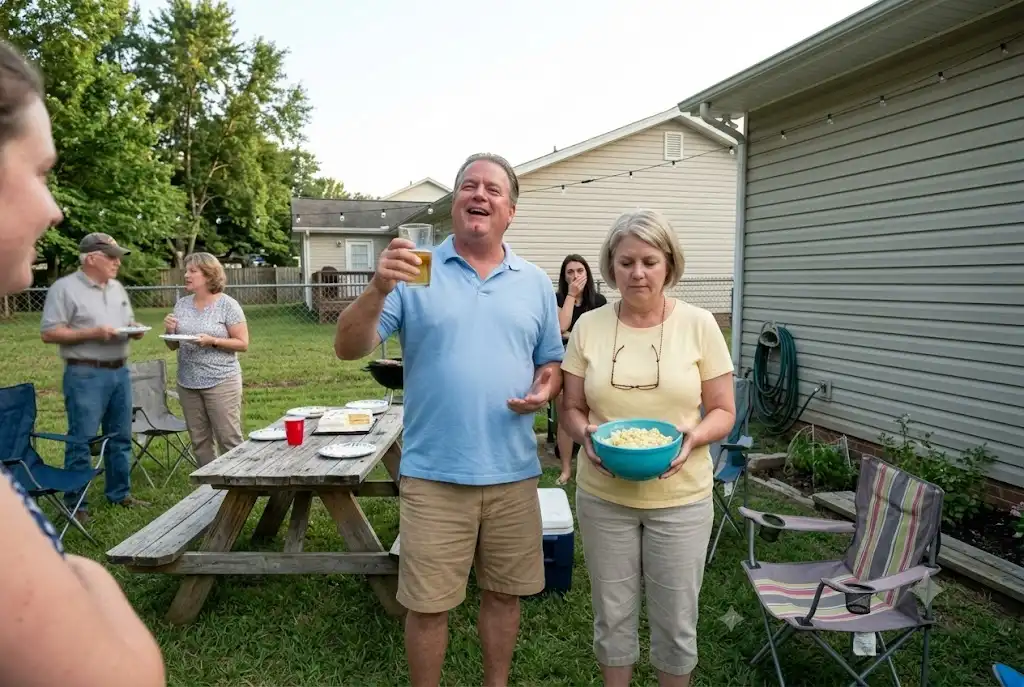
At 4:52 on a Saturday afternoon, Rick Denning tapped a fork against his beer glass and waited for the backyard to go quiet.
It was his fifty-seventh birthday.
He liked an audience, and he had one.
Twelve neighbors stood around the patio holding paper plates.
Carol was beside him, holding the bowl of potato salad she had made at six that morning.
“I want to thank y’all for coming,” Rick said.
He smiled the smile he used on customers.
“And I want to be honest with the people I care about.”
Carol felt the bowl grow heavy in her hands.
“Carol and I are going our separate ways.”
Somebody’s lawn chair creaked.
Down by the grill, their daughter Jenna put a hand over her mouth.
“It’s friendly,” Rick went on.
“We’re grown-ups. I’m starting fresh.”
He raised his glass a little higher.
“Carol gets the old wagon. And the cat.”
A few people laughed, because they thought it was a joke.
It wasn’t.
Carol set the potato salad down on the picnic table.
“And the house, Rick?” she asked quietly.
He laughed.
It was a big, easy laugh, the kind that made the neighbors laugh along before they knew why.
“The house?”
He looked around at the crowd.
“You never paid a single bill in this house, Carol.”
Twenty-two years.
Two roofs.
One daughter raised in the back bedroom.
Everyone turned to look at her.
They were waiting for her to cry.
Carol had expected to cry, too.
Instead, she felt oddly calm, the way she did when a column of numbers finally added up.
“All right,” she said.
That was all.
Across the fence, Dot Pruitt lowered her sweet tea and raised both eyebrows.
The party did not end.
That was the strange part.
Rick turned up the music, flipped the burgers, and told a story about a golf trip.
People ate because they didn’t know what else to do.
Carol cut the cake.
Her grandson Owen, six years old and sticky with frosting, climbed onto the bench beside her.
He had heard everything.
Children usually do.
“Grandpa said you don’t pay for anything,” Owen said, loud enough for the whole table.
“He did say that,” Carol said.
Owen frowned.
“But Grandma pays for everything. You pay for the ice cream.”
The table burst out laughing.
Jenna laughed too, wiping her eyes.
Carol smiled and handed him a paper napkin.
Rick didn’t laugh.
He was out on the driveway with his phone pressed to his ear.
His voice had gone soft and bright, the way it never went at home.
Carol could see the screen from where she sat when he turned.
Shelby.
When he came back, Dot was waiting by the gate.
“Who was that, Rick?”
“Just a client.”
“On a Saturday?”
“Sales never sleeps, Dot.”
Dot looked at Carol.
Carol was folding tablecloths.
Jenna found her in the laundry room an hour later.
“Mama.”
“I’m fine, baby.”
“You are not fine.”
“He did that in front of the whole street.”
Carol smoothed a tablecloth over the dryer.
“He did.”
“Do you want me to stay tonight?”
“I want you to take Owen home before he eats another piece of cake.”
Jenna didn’t laugh.
She hugged her mother hard, the way she had at eight years old after a bad dream.
“Whatever you need,” Jenna said.
“I mean it.”
Carol held on a moment longer than usual.
“I know you do.”
Jenna pulled back and studied her face.
“You don’t look surprised.”
Carol picked up the next tablecloth.
“Go on home, sugar.”
That night the kitchen smelled of charcoal and dish soap.
Carol sat at the table with her blue ledger open.
She had kept it for twenty-two years.
Every client she did the books for.
Every check.
Every payment.
Rick called it her church books, because the first client had been the Methodist church on Elm.
He came in and sorted the mail over the trash can, the way he always did.
He held up a long white envelope.
“Your mama’s still getting mail,” he said. “Trustee, Ruth Albright Trust.”
He grinned and tossed it on the junk pile.
“She’s been gone nine years, Carol.”
“You’d think the bank would catch on.”
He went upstairs without waiting for an answer.
Biscuit, the gray tabby, hopped onto the counter and pushed the envelope off the edge with one paw.
It landed at Carol’s feet.
She picked it up.
She didn’t open it.
She knew what it said.
She slid it into the back of the blue ledger.
Carol’s mother had not been a warm woman.
She had been a careful one.
Ruth Albright had worked at a feed store for thirty-one years and never once bought anything on credit.
On Carol’s wedding day, she had fixed Carol’s veil in the church hallway.
Rick’s laugh was already echoing from the fellowship hall.
Ruth had leaned in close.
“A woman keeps her own roof, Carol Ann.”
Carol had laughed at the time.
She had been twenty-six and in love.
Six months before that wedding, Ruth had driven Carol to a law office on Main Street with oak walls and a green lamp on the desk.
A younger Harold Whitmore, beard still more brown than white, had slid a thick folder across to her.
“Your mama wants this done right,” he had said.
“Sign here, and here, and here.”
Carol had signed.
Ruth had watched every stroke of the pen.
The week after the birthday, Rick got careless.
Maybe he thought there was nothing left to be careful about.
On Monday, he came home at nine.
“Dinner with a client.”
On Wednesday, Carol went to his truck for the jumper cables.
A curtain swatch lay on the passenger seat.
It was sage green linen with a price tag still attached.
Their living room curtains were blue.
On Thursday, he left his phone face-up on the counter while he showered.
A text lit the screen.
Can’t wait to see the kitchen.
Carol read it once.
Then she went back to the ledger.
When Rick came down, she asked him one question.
“Is Shelby a client?”
He didn’t look up from his coffee.
“Shelby is just a client.”
On Friday evening, Rick put a stack of papers on the kitchen table.
Carol recognized the kind of paper.
It was heavy and had a lawyer’s name printed along the bottom.
Brent Kessler, Attorney at Law.
“Brent drew it up,” Rick said.
“Keeps it simple. Keeps it cheap.”
He pulled out a chair and sat down, which he rarely did at this table.
“I keep the house and the savings account.”
“I see.”
“You keep your wagon and the cat.”
“I heard.”
“And my boat and my retirement stay mine. Those were mine before we got serious, so Brent put in a clause.”
He tapped a paragraph with one thick finger.
Carol put on her reading glasses.
She read the first page.
Then the second.
Then all eleven.
Rick checked his phone twice while she read.
The third time, he sighed.
“It’s not a novel, Carol.”
She reached the paragraph he had tapped.
Each party retains all property held solely in their own name.
She read it twice.
Then she looked up.
“I’d like one change.”
He leaned back and crossed his arms.
“Here it comes.”
“Just one.”
“What?”
She turned the page so he could see it and pointed with her pen.
“Right here, after ‘in their own name.’ I’d like it to say ‘or in trust.’”
Rick stared at her.
Then he laughed, the same big laugh from the backyard.
“In trust.”
“Yes.”
“What trust, Carol? Your Christmas club at the credit union?”
She didn’t answer.
She just held out the pen.
He shook his head, still smiling.
“Fine. Put whatever you want.”
“If it makes your little bookkeeping brain feel better.”
He took the pen, wrote three words in the margin, and initialed beside them.
R.D.
He didn’t read it again.
He didn’t ask what it meant.
He slid the page back across the table and picked up his phone.
Carol capped the pen.
She slid the page carefully into the blue ledger, right beside the long white envelope.
“Thank you, Rick,” she said. “That’s all I needed.”
He was upstairs before she stood.
Carol stayed in the kitchen until she heard the shower start.
Then she picked up the house phone and dialed a number she had never deleted.
It rang three times.
“Whitmore Law.”
The voice was older now.
It still took its time.
“Mr. Whitmore, it’s Carol Denning. Ruth’s girl.”
There was a short pause on the line.
“Carol Ann. I wondered when you’d call.”
“He signed it.”
“Did he read it?”
“No, sir.”
Another pause.
She could picture him taking off his glasses.
“Thursday at ten, sugar.”
“Bring your mama’s folder. And bring that ledger.”
“Yes, sir.”
“And Carol Ann?”
“Yes?”
“Don’t tell him anything you don’t have to.”
“I never have,” Carol said.
On Saturday morning, Carol drove to the grocery store for eggs and cat food.
She was in the checkout line when her phone buzzed.
It was Dot.
Carol answered.
Dot didn’t bother with hello.
“Sugar, are you expecting company?”
“No. Why?”
“Because there’s a young woman on your front porch.”
Carol set the eggs down on the belt.
“What’s she doing, Dot?”
There was a pause while Dot looked out her window.
“Honey, she’s got a tape measure.”
“A tape measure?”
“She’s measuring your windows.”
Carol looked at the cat food in her cart.
Then she paid, and drove home.
The story continues in Part 2.