Let the Grown-Ups Run It — Part 1
A gold pocket watch rides in Ruth Sutton's good gray slacks all evening. Forty-four years at the shop end with a toast she never saw coming.
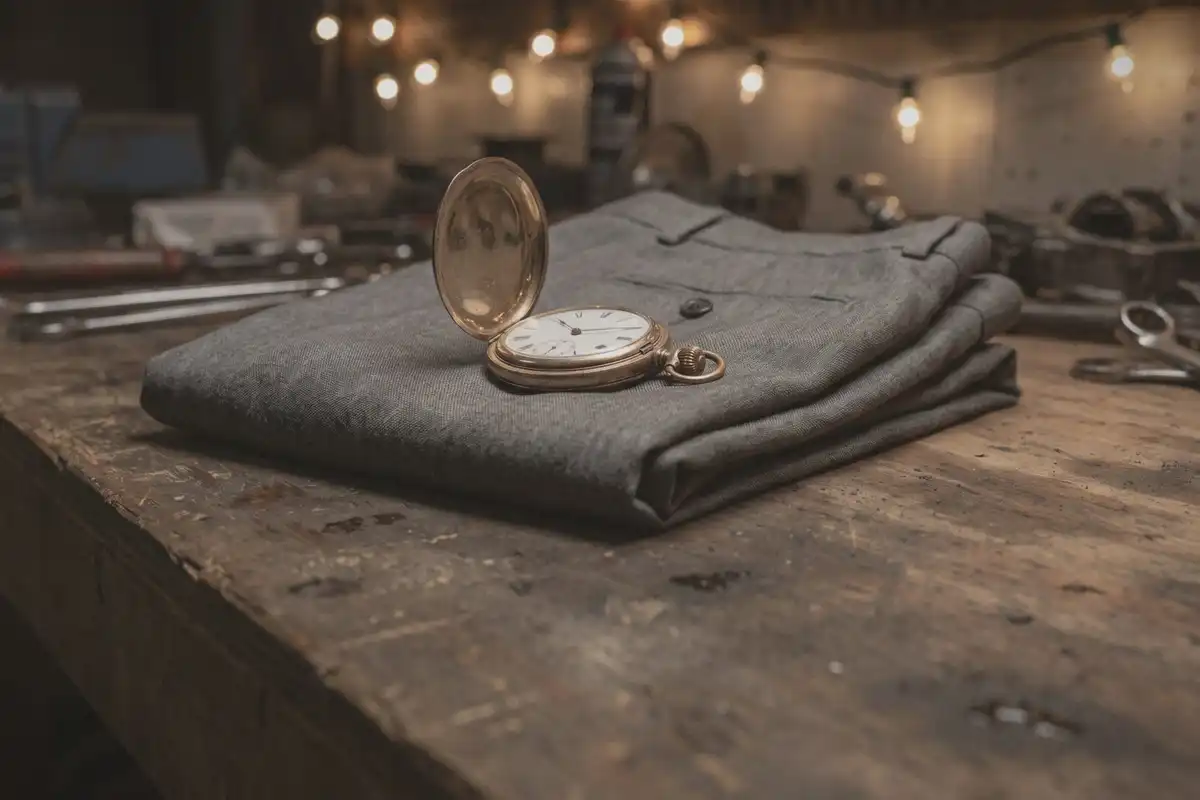
My late husband’s pocket watch was riding in my good gray slacks when my son raised his glass.
I had carried it all evening. I kept touching it through the cloth, the way you keep touching a sore tooth with your tongue.
Five months of my evenings were inside that little gold case. More than a hundred pieces, every one of them cleaned and oiled and set back where it belonged.
It was Saturday, June 13, a little after 7:30. We were standing in the middle of my shop.
Sutton Auto Repair. Forty-four years of my life. The boys had swept the bays, lowered the lifts, and strung white lights from the rafters.
There were about ninety people there. Customers, mostly. Folks whose trucks I had kept running since before their children could drive.
Kevin tapped the microphone twice. He’s my oldest, 45 years old. He had on a new blue shirt with the creases still in it, and a man I barely knew stood right behind his shoulder, smiling like he owned the building.
Kevin lifted his glass toward me. “Mom, your time is done. Let the grown-ups run it.”
The man behind him laughed first. Then a few others did. My daughter, Amanda, gave a little laugh too, and looked down into her cup.
I didn’t say a word. I took my hand off the watch and left it right where it was.
I had brought that watch to give to my son. He never got it. Just before that toast, he told ninety people he was putting his house on the line.
Somewhere in fourteen years, he had forgotten whose land that house sat on. The bank had reminded him the day before. He raised his glass anyway.
Keeping the watch in my pocket was the easy part. The hard part came eight days later, at my own supper table.
My name is Ruth Sutton. I’m 69 years old, and I have been a mechanic for most of my life.
I don’t mean I married one. For forty-four years, customers walked into my shop, looked right past me in my coveralls, and asked if my husband was around. My husband worked on power lines for the electric cooperative.
He could wire a whole house on the side, but he couldn’t tell a carburetor from a coffee can. The shop was mine.
I learned in my daddy’s two-pump filling station here in Harlan Springs, Tennessee, about halfway between Chattanooga and Knoxville. I was 12 years old in 1969 when he first let me pull the head off an engine. I wanted to skip ahead.
I wanted to go straight to putting it back together, shiny and new. Daddy took the wrench out of my hand and said, “Ruth, you can’t rebuild an engine you never learned to take apart.”
In March of 1982, when I was 24, I bought an old service station out on the state highway and painted my own name over the door. Four bays. A hand-me-down lift, a used air compressor, and a bank note that scared me half to death.
By the time I retired, that building was long paid off.
Forty-four years of engines teaches you a few things. It teaches you that a noise you ignore only gets louder.
It teaches you not to throw parts at a problem until you have found the fault. And it teaches you that the loudest man in the waiting room is usually the one who’s behind on his payments.
My husband’s name was Harold. He climbed power poles for forty-two years.
He was tall and slow-talking, and he whistled when he was nervous. Whenever something in a house acted strange, a light flickering or a breaker tripping, Harold would say, “Check the ground first.”
Most of the time, that was the whole problem. A bad ground makes everything else act crazy.
Harold passed on a Tuesday in November of 2018. A stroke, in the parking lot of the cooperative, two years short of his retirement. He was 63.
After he was gone, people in town started talking to me slower. The widow voice.
As if grief had shaken a few of my bolts loose. I let it go.
It belonged to Harold’s granddaddy, who went to work as a brakeman on the railroad in 1926 and bought that watch with his first real money. Railroad men had to carry a watch that met a strict standard, because two trains on one track with two different times is how people get killed.
A gold-filled case. Twenty-one jewels.
Harold carried it every day of his working life. In 2017 it quit on him, and he carried it anyway. He would hold it up and say, “Still right twice a day, Ruth.”
After he passed, I put it in his dresser drawer with his reading glasses and his pocketknife. I didn’t open that drawer for a long time.
This past January, when I told everybody I would retire in June, I took the watch out. I decided I would fix it and give it to Kevin at my retirement party. Harold would have wanted his son to carry it.
Now, I am not a watchmaker. But a watch is an engine. A very small, very patient engine.
I bought a set of jeweler’s screwdrivers and a magnifying lamp, and I checked out every library book I could find about watches. For five months of evenings, January through May, I sat at my kitchen table and took that watch apart one piece at a time.
I laid every part out in order on a clean white shop towel, the way Daddy taught me to do with engines. More than a hundred pieces. Some of them smaller than a grain of rice.
I found a broken mainspring and a worn-out pivot. I ordered the parts from a supply house up north and waited on them like Christmas.
The first night, when I pried open the back of the case, I found something scratched into the inside of the lid. Old watch repairmen used to scratch little marks in there, dates and codes, so the next man would know what had been done.
And under them, in Harold’s handwriting, scratched with a pin, were these words. “For Kevin, when he’s steady. Dad, 2012.”
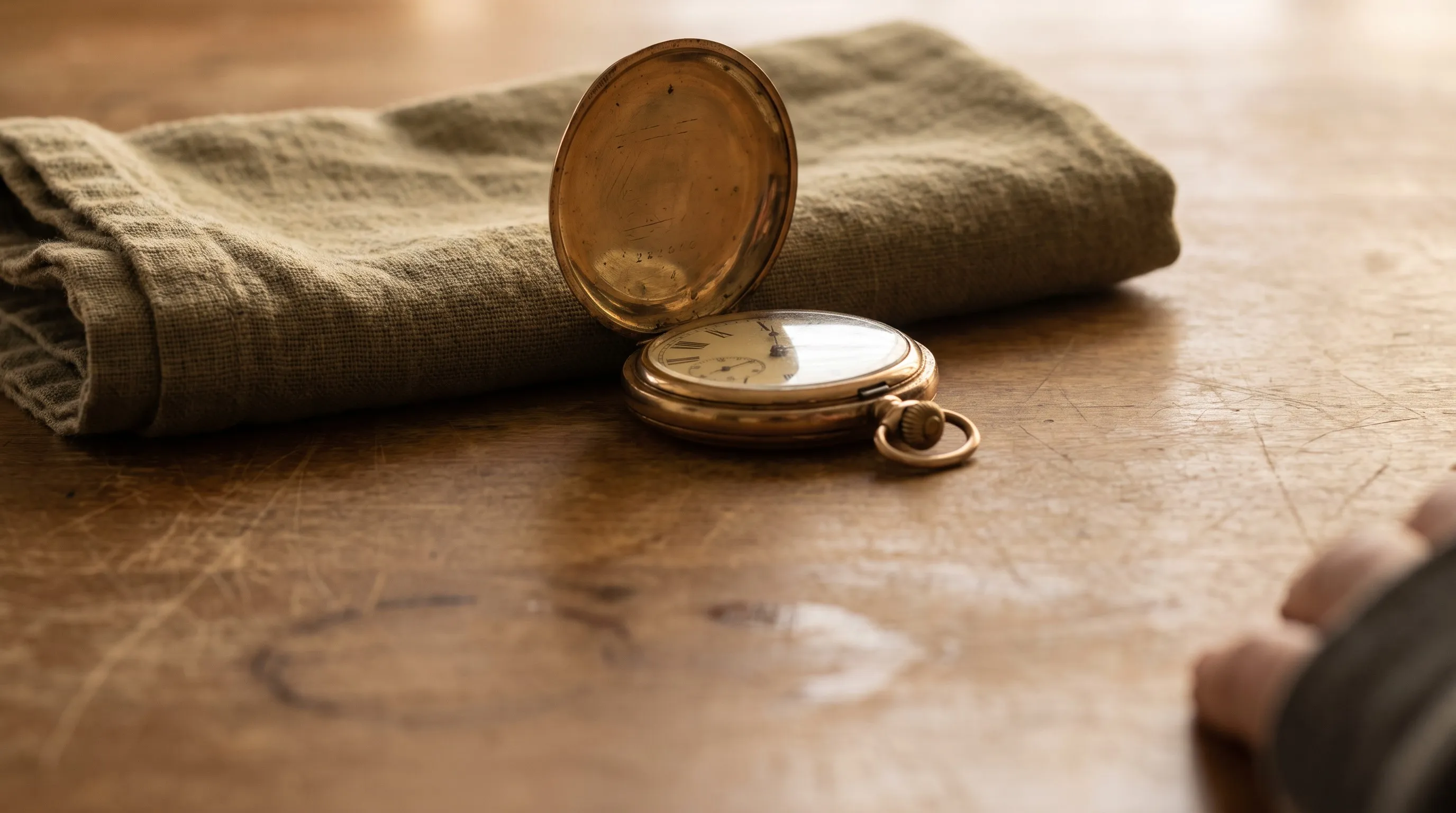
I sat at that table and cried until my magnifying lamp fogged up.
In September of 1979, the year after we married, Harold and I bought fourteen acres on the edge of town, with a tired old farmhouse from 1938 sitting on the front of it. We paid $1,500 an acre. That came to $21,000.
The deed says Harold Sutton and wife, Ruth Sutton. We raised our children in that farmhouse.
In the fall of 2011, Kevin was 30 years old and just getting back on his feet. A few years before, he’d had a used car lot that went under in the recession and left him owing more than he could pay. He wanted to build a house.
Harold walked him to the back of our property, down by the creek, and paced off two acres with his boots. Then he shook Kevin’s hand and said, “When you’re steady, son, we’ll put it on paper. Till then, the dirt stays with us, where nobody can take it from you.”
He meant the people Kevin owed. If that land had been in Kevin’s name back then, any one of them could have put a claim on it.
So Kevin built his house in 2012, on our land. Harold signed the county building permit as the owner, and Kevin signed it as the builder.
That first year, Kevin had more sweat than money. Harold did the wiring for free. My foreman and the boys from the shop helped frame it on Saturdays, for barbecue.
I paid $14,000 for the well and the septic and never asked for a dime of it back. Kevin moved in the week before Thanksgiving, with plywood floors and no porch.
Over the next few years, he and his wife put about $90,000 out of their paychecks into that house. Real floors first, then the siding and the porch.
That house has its own mailbox and its own address. But it never had its own deed.
To this day it sits on one parcel, with one tax bill, and the county mails that bill to me every October. Harold used to write the check. Since he passed, the bank drafts it straight out of my account.
Every month since January of 2013, Kevin has sent me $150 for what he calls his share of the taxes. Somewhere along the way, I believe he started to think of that $150 as proof that he owned the place.
He paid off the last of his old debts in 2015. Then in 2016, his marriage came apart.
His wife’s lawyer wanted the house sold and the money split. It couldn’t be sold. It wasn’t Kevin’s to sell.
A week after the divorce was final, Kevin mailed Harold and me a card. I still have it. It says, “Mom and Dad, thank you for keeping the land in your names. It’s the only reason I still have a roof. I won’t ever forget it. Kevin.”
After Harold died, my lawyer filed his death certificate at the courthouse with a sworn statement, the way you’re supposed to. From then on, the county’s land books showed one owner. Me.
Here is my share of the blame, and I won’t dodge it. I never sat Kevin down and said it plain. I didn’t want him to feel like a renter in his own home.
I thought a handshake and a thank-you card and all those Sunday dinners would hold everything together. I let silence carry a promise that needed paper.
Kevin grew up in my shop, and he hated nearly every hour of it. He hated the grease under his fingernails.
He hated the smell of brake cleaner in his school clothes. When he was in the seventh grade, a boy told him his mama wore the pants and the coveralls in his family, and I don’t believe Kevin ever got over it.
He wanted a desk and a necktie. He took business classes, had the car lot, and sold cars for a while.
Kevin can talk. After Harold died, I couldn’t keep up with the counter and the bays both, not with my head where it was, and Kevin came to work for me in January of 2019.
For seven years he ran my counter. Quotes, phones, billing. He could sell you a brake job with a smile.
But he couldn’t have told you what a caliper does, and he never once asked to learn. He liked it when the younger customers called him boss. He had a truck payment about the size of a mortgage.
My daughter, Amanda, is 41. She schedules appointments at the hospital over in the next county. When she was a little girl and her daddy and her brother got to arguing, Amanda would go to her room and turn the radio up.
She has been turning the radio up ever since. She loves me.
She calls on my birthday and brings a pie at Thanksgiving. But when there’s trouble, she is the hardest person in my family to find.
Amanda’s girl, Brooklyn, is 17, and if you lined up every child in Harlan Springs, she’s the one I’d pick to take after me. When she was 14, she took the carburetor off Harold’s old 1971 pickup in my garage, cleaned it, and put it back together.
The truck started on the second try. She came to work at the shop the summer after she turned 15, sweeping floors and sorting parts.
By this spring she was doing oil changes with my foreman standing right beside her. Kevin called her the grease monkey. She pretended not to hear it.
My foreman is Otis. He’s 62. He came to me in April of 1995, when he was 31 and the tractor plant had just shut its doors.
He was the best diagnostic man I have ever worked beside. He could hear a bad wheel bearing from across the parking lot. I made him foreman in 2004.
In thirty-one years, he has been late to work twice, and both times it was a baby being born. He has always called me Boss, and he has always meant it kindly.
And then there was Chase Dillard.