My Son's Wife Empties Bedpans — Part 1
Eleanor introduced her daughter-in-law to a room full of guests with one cruel line. She never asked who was sitting by the kitchen door.
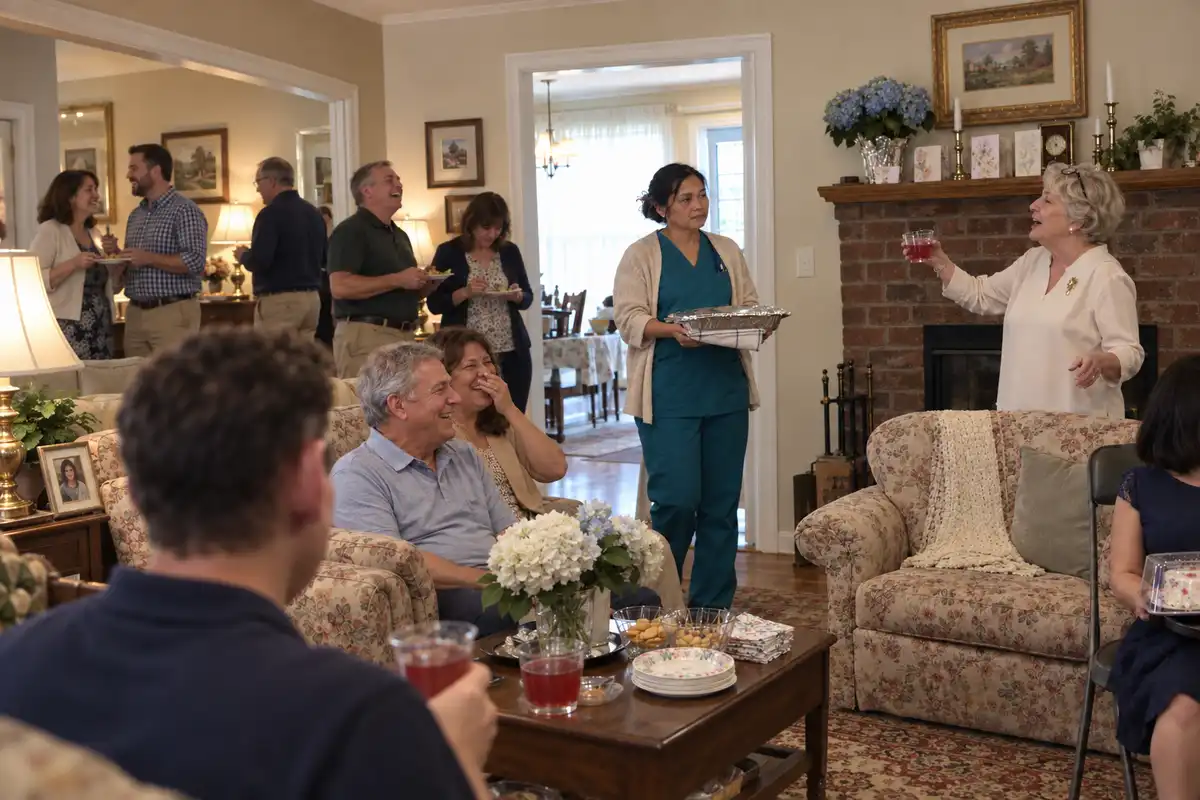
At 2:41 on a Saturday afternoon, Marisol Reyes carried a tray of pancit through her mother-in-law’s front door, still wearing her scrubs.
She had come off a twelve-hour night shift at seven thirty that morning.
She had slept three hours.
She had cooked the noodles in between.
Eleanor Prentice was standing at the fireplace with a cup of punch, in the middle of a story about the church parking committee.
She stopped when she saw the scrubs.
“Well,” she said. “Here she is.”
A dozen faces turned.
Eleanor lifted her cup in Marisol’s direction, the way a person points out a piece of furniture.
“This is my son’s wife.”
She waited half a second. She always waited half a second.
“She empties bedpans for a living.”
The room laughed.
Not all of it. Enough of it.
Marisol stood in the doorway holding eleven pounds of noodles and let it pass, the way she let an alarm finish on a monitor she had already checked.
She had expected to feel it in her face.
What she felt was the tray, and her left wrist, and the cold air still coming in behind her.
“Where do you want this?”
Eleanor waved toward the kitchen without turning around.
“Somewhere in the back, dear. The table’s set.”
The table was set.
A glazed ham, a cut-glass bowl of ambrosia, and a bakery cake with seventy on it in gold.
Marisol put the pancit on the folding table by the washer, beside the stack of paper plates.
She washed her hands at the kitchen sink and dried them on the towel she had bought in March, because the old one had gone gray.
The pantry door was open behind her, stocked to the second shelf.
She had done that on a Tuesday.
Dean found her there with a beer in his hand and an apology already on his face.
“She’s had two cups of that punch.”
“I know.”
“She’s from a different time.”
Marisol shut off the faucet.
“She’s seventy today,” she said. “Go be her son.”
He kissed the side of her head and went back out.
Marisol took her gift out of the tote bag and set it on the pile by the piano.
A robe, the heavy kind, because Eleanor’s hands stayed cold until ten in the morning and she would not touch the thermostat before then.
Eleanor took it, felt the weight of it, and set it down without looking.
“You shouldn’t have.”
The doorbell rang.
Dot Hanley came in from two doors down with a hydrangea in a foil pot, and Eleanor’s voice went up half an octave.
“Dorothy. Look at you.”
Marisol heard the voice change from the kitchen doorway.
It was a nice voice. It just wasn’t for everyone.
At 3:05, Lia was sitting on the third stair with a paper plate on her knees.
She was eight, and she had been watching the room the way her mother watched a hallway.
“Mom.”
“Mm.”
“Why does Grandma never say your name?”
Marisol sat down on the step below her and pulled the cardigan closed over her scrubs.
“She says it when she needs me.”
Lia thought about that for a while.
“She knows Mrs. Hanley’s dog’s name.”
There was no answer to that, so Marisol handed her a napkin and let it go.
Eleanor had a subject that afternoon, and she was not going to waste a full room on anything else.
“Cedar House,” she said.
“The garden units. Not the other building.”
Dot Hanley asked how long the waiting list was.
“Three years.”
Eleanor let that sit a moment.
“For most people.”
Somebody by the piano asked when she would hear.
“Any day now. They like to meet the family before they decide.”
She smoothed the front of her blouse.
“So I invited the woman from the office myself. Wrote it on a card and mailed it.”
“And is she coming?”
Eleanor looked around her living room, at forty people eating off her good plates.
“I’ve never laid eyes on her,” she said. “And nobody from an office drives out on a Saturday.”
There was a woman sitting in the chair by the kitchen door.
Nobody ever sat in that chair, because the door swung into it.
Navy dress. Flat shoes.
A grocery-store lemon cake on her lap, still under its blue plastic lid.
She had been there for over an hour, and nobody had introduced her.
Eleanor came past with the punch ladle still in her hand.
“Take that cake off her lap, would you, and put it in the back with yours.”
Marisol took the cake.
Then she went to the folding table, made up a plate, and brought it back.
Ham, ambrosia, and a fork.
“I’m sorry nobody’s fed you.”
The woman looked up.
“Mrs. Reyes?”
Marisol stopped with the plate still in her hand.
Nobody in that house called her Reyes. Eleanor addressed her Christmas cards to Mrs. Dean Prentice.
“Claudia Barnhart,” the woman said.
“We’ve spoken. Twice, I think.”
“Both times on the phone.”
Marisol set the plate down on the little table by the chair.
She knew the name.
She had typed it fourteen times in March, on fourteen pages, at her own kitchen counter, after a shift.
Claudia Barnhart, Director of Resident Services.
Alderwood Terrace.
Cedar House.
Behind them, in the living room, Eleanor had started the story again for somebody who had just walked in.
The envelope had come in February, and Eleanor had carried it around the house for two days before she put it on the table in front of Marisol.
Cedar House was the independent wing. Private entrance, garden units, a three-year list.
Eleanor had been talking about it since the previous spring, at every dinner, in the way other women talk about a cruise.
She had filled out the first page herself.
Name. Date of birth.
Church, and her former position with the school district, which she wrote out in full.
Under FAMILY CONTACT she wrote Maricel R.
Then she pushed the rest across the table, because her handwriting got tired, and because there were medical sections.
Marisol did them at the counter over three nights.
Medication list. Surgical history.
The hip in 2019.
The name of the cardiologist, which Eleanor could never remember and Marisol could.
Two questions on page nine.
Falls in the past twelve months. Eleanor said none.
There had been two. The garage in May, the tub in August, and Marisol had driven her both times and sat in the same orange chair in the emergency department until after midnight.
Manages own medications independently. Eleanor said yes.
Marisol filled the organizer every Sunday after church, seven days, four compartments a day, and left it on the counter by the coffee.
She had not corrected either answer.
She had told herself she would say something before anybody came out to do the family visit.
Nobody had ever come out.
She had not told Dean about the garage, either, because Eleanor had asked her not to, in the car, with her hand wrapped in a dish towel.
The last section was the personal statement.
Eleanor kept that page. She wrote it at her own dining table with her forearm curved around it like a girl guarding a test, and she sealed the envelope herself before Marisol could see it.
The only thing left was the signature line at the bottom of page fourteen.
Responsible party.
The family member the community would call, and ask, and believe.
Marisol signed it, because Eleanor asked her to, and because in eleven years it was the only thing Eleanor had ever asked her for.
At 3:52, a cousin arrived late and apologized twice for the traffic.
Eleanor took his coat and steered him toward the fireplace, and Marisol heard it start again from the kitchen.
“And that’s my son’s wife, over there. She empties bedpans for a living.”
The cousin laughed, because everybody did.
It was the kind of line that only worked in a room where nobody knew what a charge nurse did all night.
Six feet away, the woman in the navy dress cut a piece of ham and did not look up.
She did not write anything down.
She did not have to.
Joan Kessler saw it.
Joan had spent sixty-seven years two steps behind her sister, watching her rehearse introductions at the hall mirror before company came.
Nothing Eleanor said in a full room was an accident.
Joan put her cup down on the mantel.
At 4:12, in the hallway by the coat closet, Eleanor was explaining how she planned to break the news to the bridge group.
“I’ll wait until we’ve dealt the second hand.”
“Then I’ll just mention it. Like it’s nothing.”
Joan was not listening.
Joan was looking past her shoulder, at the chair by the kitchen door.
“Eleanor.”
“And Dot will ask what the waiting list was, and I’ll say three years, and I’ll let her sit with that.”
“Eleanor.”
“What.”
“That woman by the kitchen door.”
Eleanor turned around.
“Who did you tell me she was?”
The story continues in Part 2.