Some Women Are Just Help — Part 1
For four years Priya carried the dishes at her mother-in-law's Christmas table. This year she brought a guest, and nobody asked who she was.
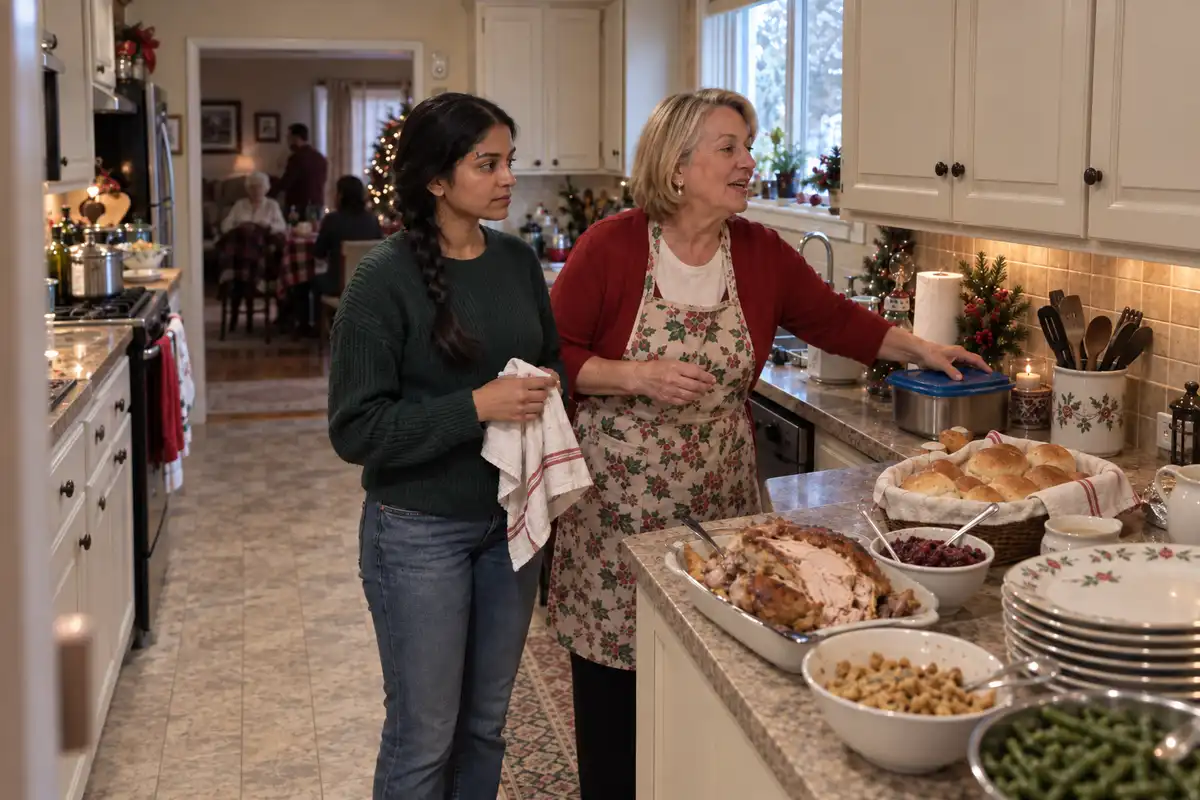
At 7:10 a.m., still in her scrubs, Priya Raman sat in the hospital parking garage and made a call she had not mentioned to her husband.
“Sunrise Meadows, front desk.”
“This is Priya Raman. I’m picking up Eleanor Voss at three.”
Paper shuffled on the other end.
“You’re the nurse.”
“I was.”
“Most of them don’t come back.”
Priya watched a man two rows over scrape frost off a windshield with a credit card.
“She doesn’t have anybody for Christmas,” she said. “I checked twice.”
“Most of them don’t check either.”
“She has a bed and three meals. That’s not the same as having somebody.”
Priya hung up and sat there a minute longer with the engine off.
Twelve hours on the cardiac floor.
Two codes, one of them at four in the morning.
A family in the corridor who needed somebody to say the same three sentences to them four times before the sentences went in.
A woman in 409 who kept asking for her husband, who had died in 2011.
Priya had expected to feel wrung out. Instead she felt steady, the way she did before a long shift rather than after one.
She drove home and started the milk on the stove before she took her shoes off.
Adam came down at ten with his phone in his hand and kissed the top of her head.
“Mom’s fine about the extra chair, right?”
Priya stirred the pot.
“I didn’t ask.”
He laughed, because he thought she was joking, and she let him.
The kitchen filled with the smell of cardamom and scorched sugar at the edges, which was how it was supposed to smell.
Payasam. Her mother’s proportions, written in pencil on the inside of a recipe card that had gone soft as cloth.
She made it every December 24th and carried it to her mother-in-law’s house every December 25th.
“They send the panel decision on the twenty-seventh,” Adam said.
He said it to the refrigerator.
“Regional director. Four of us in it.”
“You’ve been in it since August.”
“It’s not the hiring people anymore. It’s the board now.”
He scrolled.
“There’s a name on the memo nobody at the office has ever met. Not once.”
“Who?”
“Voss.”
Priya’s wooden spoon went around the pot.
“E. Voss,” he said. “That’s the whole name on it.”
“Sounds like a man who doesn’t like meetings.”
“That’s what everybody says.”
“Then somebody should ask.”
“Nobody’s going to ask, Priya.”
She poured the payasam into the good steel container, the one with the blue lid, and set it by the door where she would not forget it.
Four years she had carried that container into her mother-in-law’s kitchen.
Four years it had come home with the lid still sealed.
At 1:00 p.m. Lorraine Whitfield opened the door with her arms already out, and Adam walked into them.
“There he is. There’s my boy.”
Priya stood on the step with the container in both hands and her coat over her arm and waited to be let by.
Lorraine let go of her son, looked at the container, and took a dish towel off her shoulder.
She put it in Priya’s free hand.
“You’re so good with your hands, sweetheart.”
The house smelled like cinnamon from a plug-in by the stairs. Every surface had something red on it.
Priya carried the payasam to the counter.
Lorraine followed her, still talking about the roads, and moved it — not rudely, not even looking at it — behind the jar of pickled onions at the back, where the light didn’t reach.
“We’ll see if there’s room,” she said.
There had never been room.
Priya hung her coat on the end of the stair rail, because the closet by the door was full of Lorraine’s coats and had been full of Lorraine’s coats for four years.
She rolled the dish towel once and set it on the counter.
She did not put it down hard. She just did not carry it around.
In the living room, Grandma Ruth sat in the wing chair by the window with a blanket over her knees and her hands folded.
Ruth was eighty-three. She had stopped talking much about three years ago.
She had not stopped counting.
She watched the towel go from Lorraine’s shoulder into Priya’s hand, and her chin moved a quarter inch.
Hannah came in from the den with a wine glass and a bright face.
“Priya! You look tired.”
“Night shift.”
“You should tell them no sometimes.”
Hannah lowered her voice, friendly, conspiratorial.
“Mom just likes things her way. You know how she is.”
Priya said she knew how she was.
Maya, who was nine, came around her mother’s legs and stopped in front of Priya with a serious expression.
“Are you making the rice pudding?”
“I already made it.”
“Where is it?”
Priya looked at the counter, at the jar of pickled onions.
“It’s waiting,” she said.
Maya considered this.
“Waiting for what?”
Priya did not have an answer that a nine-year-old could be given at somebody else’s Christmas, so she crouched down and straightened the collar of Maya’s dress instead.
“For somebody to ask for it,” she said.
At 3:15 the doorbell rang, and Priya was the one who got up.
She came back in with her arm under Eleanor Voss’s elbow, taking the step down into the living room at Eleanor’s speed, which was not fast.
Eleanor was seventy-four.
She wore a gray wool dress and flat shoes and a very old watch with a cracked leather band.
She looked at the room the way people look at a room they have already decided to be pleasant about.
Conversation stopped the way it does.
Lorraine stood up with her hostess face on, the one that arrived a half-second before the words.
“Well, hello. And you are?”
“This is Ellie,” Priya said. “She was my patient.”
Lorraine heard one word out of that sentence.
“Oh,” she said warmly. “Oh, bless your heart, honey.”
She pulled out the chair at the end of the table nearest the kitchen door, the one where the draft came through when the oven was open.
“You’ll be comfortable right here.”
Eleanor sat down in it without a word about it and put her hands in her lap.
Adam shook her hand and said it was nice to meet her and went back to his phone.
Priya brought Eleanor a cup of coffee.
Eleanor looked at it, then up at her, and her face changed the way a face changes when it is recognized.
“You remembered.”
“You don’t take sugar.”
“Eleven days in that place and one person got it right.”
Eleanor put her hand flat on the table, next to the cup, not touching Priya, just near her.
“I’d have taken it with sugar and said nothing. That’s the part people don’t know about us.”
“I know about it.”
“You do.”
Across the table, Ruth was watching the two of them.
She had not looked at her own daughter in twenty minutes.
At 3:40 they started carrying things in, which meant Priya started carrying things in.
Lorraine narrated from the head of the table — the turkey, the brine, the recipe from her mother, who had been from Savannah and had done it properly.
Hannah arranged the rolls twice and moved the candles once, and then stood back to look at what she had done, and moved them again.
Adam poured wine and told a story about a man at his office who had backed a truck into a flagpole, and everyone laughed, and it was, for about four minutes, a nice afternoon.
Then Maya got down off her chair.
She picked it up by both sides the way children do, hauling it, banging one leg against the table, and dragged it around the long way to the end where Priya and Eleanor were sitting.
She wedged it in between them.
“I’m sitting here.”
“Maya,” Hannah said.
“Ellie was telling me about a horse.”
“I was,” Eleanor said.
Priya laughed — a real one, short, surprised out of her — and Eleanor laughed too, and Maya looked back and forth between them, delighted with herself.
Three of them down at the cold end of the table by the kitchen door.
Lorraine picked up her spoon and rang it twice against the side of her glass.
“All right,” she said, smiling. “Let’s all sit where we’re supposed to sit.”
In the kitchen, Adam stood at the counter with the carving knife in one hand and his phone in the other.
The screen had come alive while he was reaching for the platter.
One line, from the office, on Christmas Day.
Panel review — final input due Dec 27.
He read it twice.
Behind him, through the doorway, he could hear his mother’s voice starting up again, and under it his wife’s voice saying yes, she’d get it, she didn’t mind.
He turned the phone face down on the counter.
He picked up the platter.
He did not go back in yet.
The story continues in Part 2.