Nobody Is Driving Four Hours for Cake — Part 1
At 5:10 on a Saturday, Ernesto Salas ate half a cupcake alone. His daughter had told him nobody drives four hours for cake. Then the mail came.
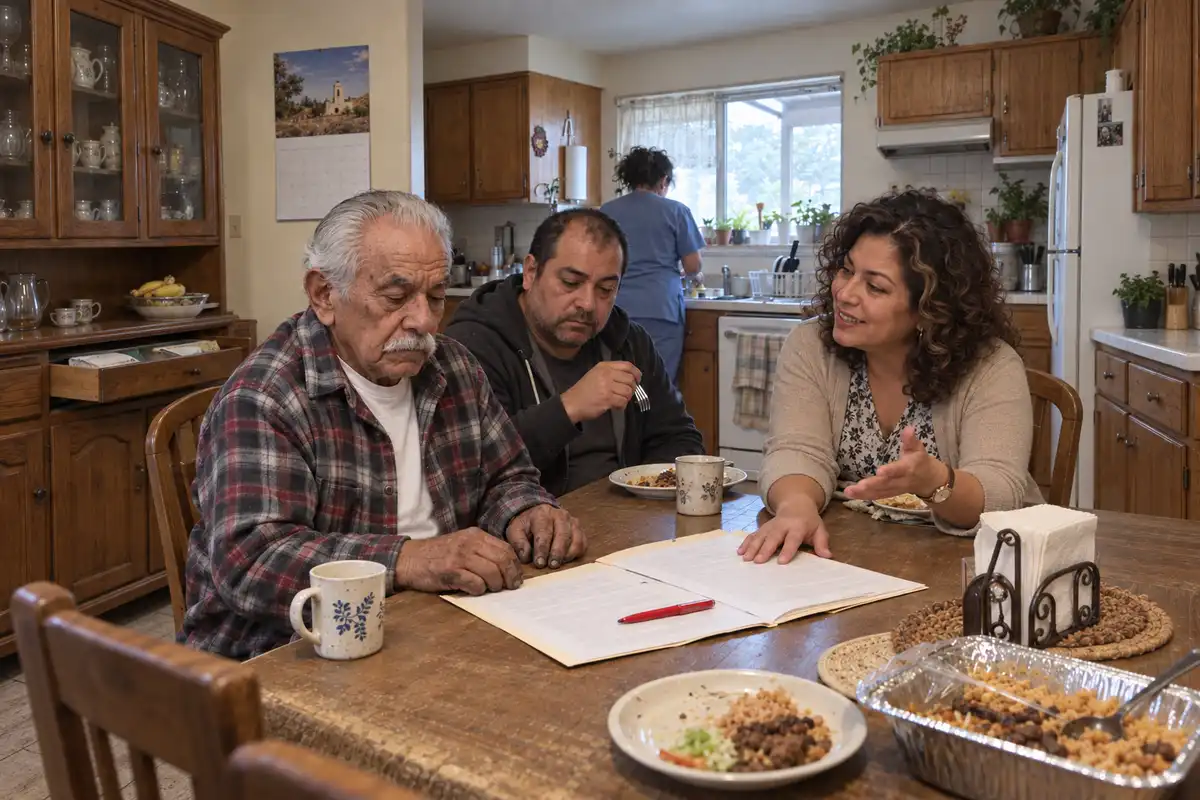
At 5:10 on the second Saturday in October, Ernesto Salas ordered one cupcake and asked Delia not to put a candle in it.
“You sure?”
“I’m sure.”
Delia Fong had run the counter at the Alder Creek Diner for twenty-six years and knew better than to ask twice.
She brought the cupcake on a saucer.
Vanilla, with the grocery-store frosting that comes out of a tube.
Ernesto set his phone on the table, face-up, next to the saucer.
Then he waited.
Three days earlier, on Wednesday, he had called his oldest.
Marisol answered on the fourth ring, and he could hear a car around her voice, the turn signal ticking.
“Dad. Hi.”
“Are you driving?”
“You’re on speaker. Go ahead.”
“I wanted to ask about Saturday.”
“Saturday.”
“The twelfth.”
There was a pause that had a steering wheel in it.
“Your birthday,” she said. “Right.”
“Eighty,” Ernesto said.
He had practiced saying it lightly.
“That’s a big one,” Marisol said, in the voice she used with clients.
“Listen, Dad. I have three showings that weekend.”
“Grant’s got the boys.”
“And it’s four hours each way.”
“I know how far it is.”
“Dad, nobody’s driving four hours for cake.”
Somewhere behind her, a woman’s voice said something about a lockbox, and Marisol laughed at it, and came back on.
“We’ll do something. Later in the month, maybe.”
“All right.”
“I’ll call you.”
Ernesto held the phone a second after she was gone.
Then he put it in his shirt pocket and went out to the shop.
He called Danny on Thursday and got the voicemail that had been full since June.
He called Rosa twice.
The first time it rang out.
The second time it went straight to her recording, which meant she had seen the first one.
He did not leave a message either time.
With Rosa it had been a year and two months.
There had been a Sunday, at this kitchen table, four months after the funeral, when she said a thing about her mother and he said a thing back.
He could not have told anyone what either sentence was.
He only knew that she had picked up her keys before her coffee was cold.
After that she sent a card at Christmas, signed with her first name only, like a nurse signing a chart.
So on Saturday he ate half a cupcake at the diner and put four dollars under the saucer.
Delia watched him do it.
“Ernie.”
“Mm.”
“Four hours isn’t the distance.”
He looked up.
“Four hours is what they’re telling you you’re worth.”
“They’re busy.”
“So am I. I’m standing here.”
Ernesto smiled at her the way you smile when your throat isn’t working, and picked up his keys, and left.
The bell over the door rang behind him.
The shop sat at the bend of Old Mill Road where the pavement gave up and turned to gravel.
SALAS & SON, the sign said, in letters his father had painted in 1961 and Ernesto had repainted eleven times since.
Inside were two bays, a parts wall, a coffee maker older than his marriage, and a 1972 Ford pickup up on blocks that he had been rebuilding for eleven years.
His wife used to call it the other woman.
Alma had been gone three years in March.
He put the radio on the station that played the old songs and got under the truck.
Somewhere around nine o’clock he came out from under it, washed his hands, and looked at his phone.
Nothing from Marisol.
Nothing from Danny.
Nothing from Rosa.
He had expected to feel something sharp.
What he felt instead was the size of the building.
Two bays.
A parts wall.
A coffee maker.
One man.
He went back under the truck until eleven.
At 12:20 in the morning, a text came in.
happy bday pop 🎂
Danny.
Ernesto read it in the dark, in bed, with the phone lighting his face.
He typed thank you, deleted it, and set the phone on the nightstand screen-down.
Monday he found the stake.
It was at the back fence line, where his property ran up against the dry ditch — a wooden stake with orange ribbon tied to the top, driven hard into the ground.
Ernesto worked it loose and carried it up to the shop and leaned it in the corner with the broom.
Kids, he figured.
Tomás Reyes came in at nine with two coffees and saw it.
Tomás was twenty-four and had been sweeping this floor since he was sixteen, and he was the only person Ernesto had ever let touch the Ford.
“Where’d that come from?”
“Back fence.”
“Huh,” Tomás said.
He looked at it a second longer than Ernesto did.
Then he handed over the coffee and went to get the lift down.
On Wednesday, Wendell Pryor pulled into the lot in a new truck.
Not new to Wendell. New.
Crew cab, chrome step bars, a temporary tag still in the back window.
“Ernie.”
“Wendell.”
“Thought you’d want to see it.”
Ernesto walked around it once, the way you do.
“What happened to the Chevy?”
“Traded it.”
“On what?”
Wendell got a look that Ernesto would think about later, much later, standing at a counter in the county building with a piece of paper in his hand.
“Sold the back forty,” Wendell said. “Some outfit out of Denver.”
“Sold it.”
“They came to me.”
Wendell tapped the door panel twice with two fingers.
“Didn’t even have to list it.”
He drove off, and the new tires threw gravel, and Ernesto went back inside and wrote up a brake job for a woman from the Methodist church.
The mail came at eleven.
Two bills, a seed catalog, and a certified letter with a law office return address in the corner.
Ernesto looked at it the way you look at a dog you don’t know.
Since Alma died he had gotten a lot of envelopes like that.
Hospital billing.
Insurance.
A man in Modesto who wanted to buy the truck sight unseen and would not stop writing.
He opened the desk drawer, put the letter in with the others, and pushed the drawer shut with his hip.
The drawer did not close all the way, because of what was already in it.
Under the envelopes, flat on the bottom, was a folded map from 1961.
His father’s parcel survey, soft as cloth at the creases.
A strip of ground along the front of the lot was outlined in pencil, freehand, the line gone brown with age.
His father had drawn that line the week he bought the place and had explained it exactly once, on a Sunday, with the truck door open and the radio on.
Ernesto had been eleven.
He had understood about a third of it.
The part he remembered was this: his father saying that the building was worth what a building is worth, and that the line was worth more.
He shut the drawer the rest of the way with his knee and went to do the brake job.
On Friday, Delia called the shop phone, which nobody did.
“What time do you close?”
“Six. Why?”
“No reason.”
At ten past six, headlights came up Old Mill Road.
Then more headlights.
Delia’s hatchback.
Tomás’s mother’s van.
Wendell’s ridiculous new truck.
The Ramirez boys, in a car with one gray door.
The woman from the Methodist church whose brakes were fine now.
They parked in a half circle facing the open bay and left their high beams on, so that the shop floor lit up white and every wrench on the pegboard threw a shadow up the wall.
Delia came in carrying a sheet cake in a box.
“Sit down,” she said.
“I don’t—”
“Ernie. Sit down.”
He sat down on the fender stool.
They sang it badly, in three different keys.
Wendell came in a full word behind everybody else, the entire way through.
At the end, Tomás’s mother yelled something in Spanish.
It made the Ramirez boys laugh so hard that one of them had to put his hands on his knees.
There were no candles on the cake.
Delia had brought a box of them and forgotten to open it.
She found them later in her coat pocket and set them on the workbench, a little cellophane sleeve with a blue 8 and a blue 0 inside.
“Next year,” she said.
“Next year,” Ernesto said.
When everyone was gone he took the sleeve out to the Ford, and opened the passenger door, and put the candles in the glovebox with the registration and a church fan and forty years of receipts.
He did not examine why.
Ernesto looked at the cake, and at eleven people standing in his shop with their car doors hanging open, and laughed out loud for the first time in a week.
“You’re all going to kill your batteries,” he said.
“Then you’ll fix them,” somebody said.
They left around eight.
Tomás stayed to help him put the chairs back and sweep up, and he was winding the extension cord when he said it.
He said it the way you mention weather.
“Hey. Your daughter find you okay?”
Ernesto stopped with the broom halfway to the corner.
“Which one?”
“The one from Sacramento. Curly hair, sunglasses.”
Tomás hung the cord on its hook.
“She was out here a couple weeks back. On a Tuesday, I think.”
“I was up on the roof, doing the swamp cooler.”
“Marisol was here?”
“She didn’t come in.”
Tomás turned around, and saw Ernesto’s face, and his own got careful.
“She drove past. Real slow.”
“Then she came back the other way and stopped up by the ditch.”
“Stopped.”
“Got out.”
Tomás shrugged, but he did it slowly.
“She was taking pictures of your fence.”
Down the hall, in the desk drawer, the certified letter lay unopened on top of a folded map from 1961.
Ernesto set the broom against the wall.
“Pictures of the fence,” he said.
“Yeah.”
“You’re sure it was her.”
Tomás looked at the floor, and then back up, because he had been raised to look people in the face when he was telling them something they didn’t want.
“I’m sure.”
Four hours south, at 9:40 that night, Marisol Salas-Webb stood at her kitchen island with a glass of wine she had not touched.
Her laptop was open to a satellite map.
She had the block zoomed in close enough to see the roof of her father’s shop, the white rectangle of it, the two dark squares of the open bays.
Her phone buzzed on the granite.
Danny.
did u go up there
She typed with one thumb.
No.
The three dots appeared, went away, appeared again.
k
She set the phone down.
Then she picked it back up, and typed a second message, and looked at it for a long moment before she sent it.
Did he say anything about a letter?
The story continues in Part 2.