Nobody Is Driving Four Hours for Cake — Part 2
Ernesto finally opened the letter. At a county counter, a clerk turned her monitor and told him what his father had really left him in 1961.
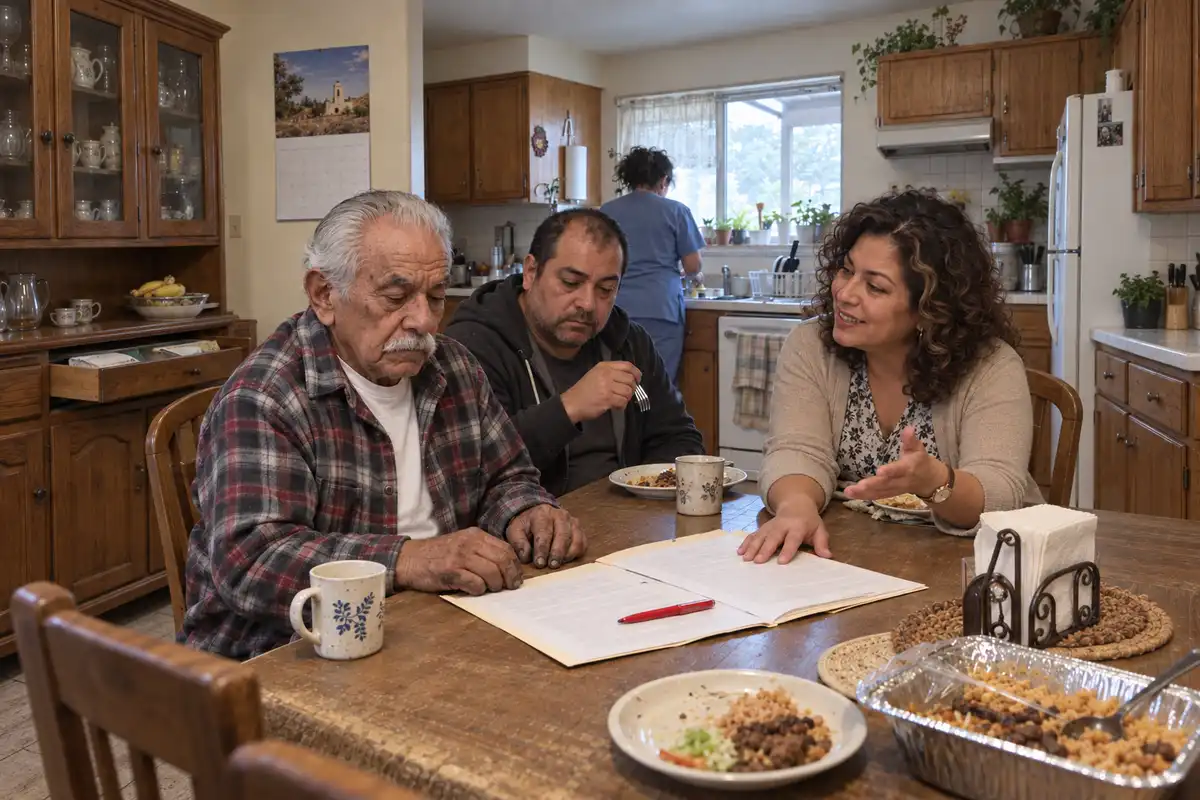
The letter sat in the drawer for eleven days.
On Thursday morning Tomás came in at 8:20 and found Ernesto standing at the counter with it in his hand, still sealed.
“You want coffee first?”
“No.”
Ernesto opened it with a utility knife, the way he opened parts boxes.
He read it twice.
Then he set it down on the counter and put one finger on a line in the second paragraph and stood there.
“Ernie.”
“It says they’ve been trying to reach me since August.”
“Who has?”
“Calder Ridge Partners.”
Tomás came around the counter and read over his shoulder, and his lips moved on the number, and then stopped moving.
“That’s the fence money?”
“That’s what they’re offering for the front of the lot.”
“The front of the lot.”
“Sixty feet of it,” Ernesto said. “Along the road.”
He looked at the number again.
“Sixty feet of dirt I’ve been parking a tow truck on since Carter.”
Friday, 10:15 a.m., the county building in Alder Creek.
The recorder’s office was one long room with a laminate counter and a window air conditioner that ran whether it needed to or not.
Ernesto put the 1961 map on the counter, unfolded, and set the letter beside it.
“I’d like to know what I own,” he said.
Ilene Boyd had worked that counter for nineteen years and did not find the question strange.
“Parcel number?”
He read it off the letter.
She typed, and waited, and turned her monitor a few degrees the way clerks do when they are about to tell you something true.
“Salas, Ernesto R.,” she said. “Recorded November 1961.”
“Your father?”
“My father.”
“There’s an access easement attached.”
“What does that mean?”
Ilene turned the screen a little more.
“It means the right to cross runs with your parcel, not with the parcels on either side of you.”
“In English, Ilene.”
“In English,” she said, “the four properties behind you have to come out through your frontage.”
“They always have.”
“No.”
She tapped the screen with one nail.
“They always have because your father wrote it that way.”
“Not because that’s how the land sits.”
Ernesto looked at the pencil line on the map.
Freehand. Brown with age.
“Nobody can build back there without a road,” he said.
“Nobody can build back there without your road.”
Down the counter, at window three, a young man in a quarter-zip stopped filling out his form.
He had a leather folder under his arm and a lanyard he had tucked into his shirt pocket, which is what people do when they do not want to be read across a room.
He did not look over.
He just stopped writing.
His name was Peter Ault and he was thirty-one and he caught up to Ernesto in the parking lot.
“Mr. Salas.”
Ernesto kept walking.
“Mr. Salas, my name is Peter Ault, I work with Calder Ridge—”
“I know who you work with. I read the letter this morning.”
“We’ve been trying to reach you since—”
“August. It said.”
Ault stopped a respectful six feet away, which was the smartest thing he did that day.
“Can I ask you a question,” Ernesto said.
“Of course.”
“How many parcels have you bought on Old Mill?”
A pause.
“Four.”
“Wendell Pryor.”
“I can’t discuss other—”
“Four,” Ernesto said. “And you can’t get a truck onto any of them.”
Ault did not answer that.
He got out a card instead and held it at arm’s length until Ernesto took it.
“You should have somebody look at the offer,” he said. “Somebody on your side.”
“That’s the first honest thing anybody’s said to me this month.”
Ernesto put the card in his shirt pocket.
Then he went home and did not call anybody, because there was nobody to call, and cooked eggs at four in the afternoon and ate them standing up.
Saturday, nothing.
Sunday, at 9:05 in the morning, his phone rang.
Marisol.
“Dad! Hi.”
“So Danny and I were talking, and we feel terrible about the twelfth.”
“All right.”
“We’re coming up. Today.”
“We’re already on the road.”
“Today.”
“Rosa’s meeting us there.”
Ernesto stood in the kitchen with the phone against his ear and looked at the calendar on the wall, which still had ALMA — DR. 10:30 written on a day in March three years gone.
“Rosa,” he said.
“She’s driving over from Fresno.”
Marisol’s voice went bright.
“All three of us. Isn’t that nice?”
“That’s four hours for you.”
There was a pause with a highway in it.
“Sorry?”
“Nothing,” Ernesto said. “I’ll be here.”
Across the valley, at 9:40, Rosa Salas sat in her car in the parking lot of a gas station outside Kerman with the engine off.
She had been there twenty minutes.
On the passenger seat was a paper bag with a coffee cake in it that she had bought at a grocery store at six in the morning because she could not think of anything else to bring.
Her sister had called her Friday night and used the word opportunity four times.
Rosa had said yes to the drive and no to everything else and then had not slept.
She started the car at 9:48.
They arrived in one wave at ten past one, the way they used to when Alma was alive and there was a reason to.
Marisol’s SUV first. Danny behind her in something borrowed with a dent in the rear quarter.
Rosa last, alone, parked out by the road as if she were not sure she was staying.
Marisol came in carrying a tray of enchiladas from a place in Sacramento, still in the store film.
Danny carried nothing and hugged him hard.
“Pop.”
“Daniel.”
“You look good. You been eating?”
“I’ve been eating.”
Rosa came in with the coffee cake and stood inside the door and said, “Hi, Dad.”
“Hello, Rosa.”
That was all either of them said for the first hour.
They ate at the kitchen table, in the chairs they had sat in as children, which nobody planned and everybody did.
Marisol talked about the boys’ soccer and the market in Sacramento and a woman from church who had died.
At 2:20 she put her fork down and reached into her bag and set a folder on the table.
Manila.
New.
A tab on the side with his name on it, typed.
“Dad, while we’re all here.”
“Mm.”
“We want to talk about the property.”
Danny stopped chewing.
“What about it,” Ernesto said.
“There’s a company assembling parcels on Old Mill.”
Marisol opened the folder and turned it toward him, square, like a listing sheet.
“It’s actually a really good moment.”
“Land in that corridor has moved a lot in eighteen months.”
“Has it.”
“And honestly?”
She smiled at him.
“The shop is a lot of building for one person.”
“It’s two bays.”
“It’s a liability is what it is.”
Danny found his voice.
“That lift alone, Pop.”
“If you drop something on your foot out there at night—”
“I’ve been dropping things on my foot out there since 1968.”
“That’s kind of the point,” Marisol said.
Rosa got up and started clearing plates.
Marisol slid a second page across.
“So what we’d do — and this is just the clean way to do it — is you’d sign the lot into a family holding, and then any offer comes to the four of us together. Simpler at tax time.”
“Whose name is on the holding?”
“All of ours.”
“Whose name signs?”
A beat.
“Mine, probably. Because I’d be the one doing the paperwork.”
Ernesto looked at the page for a while.
The heater kicked on under the floor.
“Mari.”
“Yeah, Dad.”
“When did Calder Ridge first call you?”
The kitchen went very quiet.
Marisol’s face did not move at all, which was its own answer, but Ernesto was not looking at Marisol.
He was looking at Danny.
And Danny — who had never in forty-nine years been able to keep anything off his face for longer than a second — looked at his sister.
Just once.
Fast.
Guilty as a boy with a hand in a coffee can.
At the sink, the water stopped running.
“Dad,” Marisol said. “That’s not—”
“June or July.”
“Nobody called me.”
“June or July, Mari.”
“They sent me an email.”
Her chin came up.
“One email. A market inquiry.”
“I get forty of those a week.”
“In June.”
“I don’t remember the month.”
“You remembered it well enough to come out here on a Tuesday and photograph my fence.”
Danny put both hands flat on the table.
Rosa turned around from the sink with a dish towel in her hands and did not say a word.
Marisol’s mouth opened, and closed, and when she spoke again her voice was lower and much more reasonable, which is how Ernesto knew he had it right.
“I was being careful,” she said.
“You’re seventy-nine years old, and you were about to get a call from a land company.”
“Somebody in this family has to think two steps ahead.”
“You are thinking two steps ahead.”
“Yes.”
“You’re just not walking with me.”
Nobody ate any more enchiladas.
Danny said something about the dent in the borrowed car and went out to look at it, which fooled no one.
Rosa washed every dish in the house, including the ones that were already clean in the rack.
At 4:15 Ernesto walked them out.
The three of them stood on the gravel by their three cars, in the flat gold light that comes down Old Mill Road in October.
He stood on the step above them.
They waited, because he had not said anything about the folder.
“I’ll give you my answer,” Ernesto said.
They waited.
“At that table. Four weeks from Saturday.”
“One o’clock.”
“Dad—”
“You drove four hours today.”
He put his hands in his pockets.
“You can drive it once more.”
Marisol looked at him for a long moment.
Then she picked up the folder off the porch rail, and tucked it under her arm, and kissed him on the cheek the way you stamp a form.
Rosa was last.
She stopped on the bottom step and started to say something, and Ernesto waited, and she closed her mouth and went to her car.
She had left the coffee cake on the counter.
At 5:52 that evening, four miles south of town, Marisol pulled onto the shoulder of the county road and put on her hazards.
She sat there with the engine running.
Then she picked up her phone and scrolled past Calder Ridge, and past Peter Ault, and past her brother.
She stopped on a name and a number she had saved in August.
A law office in Sacramento.
She looked at the screen for four seconds.
Then she pressed it.
“Hi — yes, I left a message with you back in the summer about my father,” she said.
“I’d like to talk about what the process looks like.”
She watched a truck go by.
“When a parent isn’t able to manage his own affairs anymore.”
The story continues in Part 3.