Farms Need a Man's Name on the Deed — Part 1
Her mother ironed her brother's shirt for the will reading and told Megan the deed needed a man's name on it. Megan had been up since 4:41.
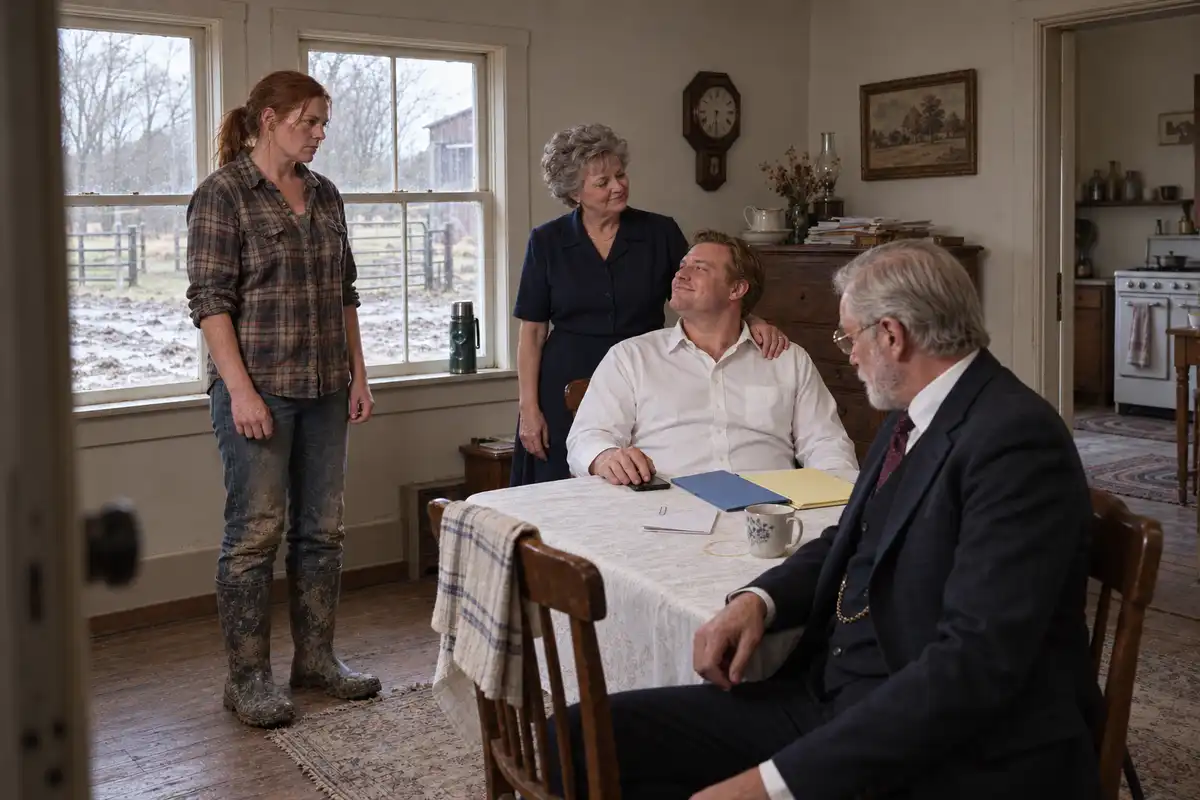
At 4:41 in the morning, Megan Holt knelt in the wet clay of the west lot.
Her father had been in the ground nine days.
The cow under her hands would not get up.
Number 118 had freshened on Sunday and gone down sometime in the night.
Megan knew the shape of it before she got the flashlight on her.
Ears cold.
Head tucked back toward her flank.
She pulled the calcium bottle out of her coat and held it against her stomach to warm it.
Cold calcium into a cold cow is a good way to stop a heart.
She tented the skin behind the shoulder and put half the bottle under it, slow, while the rain came sideways off the barn roof.
Then she sat back on her heels in the mud and waited.
At 5:06 the cow rolled up onto her chest.
At 5:20 she stood.
Megan did not say anything about it to anyone.
She took the notebook out of her coat pocket and wrote the time down, the way she had every day for ten years.
The thermos was on the fence post where she always left it.
It had a dent in one side from the summer her father dropped it off the loader and swore for a solid minute.
She still filled it to the top every morning.
She still poured two cups.
The second one went cold on the post now.
At 7:20 she came in through the mudroom and found her mother ironing by the window.
Darlene Holt was pressing a white shirt that was not Megan’s.
“Wade gets in around nine,” her mother said. “He’ll want to look right.”
Megan ran the sink until it went hot and washed to the elbow.
“Harold said ten,” Darlene said. “In the dining room.”
“I put the good cloth on.”
“I know.”
“You’re not wearing that.”
Megan looked down at her jeans, which had 118 on them from the knee to the cuff.
“I’ve got a shirt with a collar.”
Her mother turned the sleeve over and pressed the same collar a second time.
“A place like this, when it’s settled, it has to be run right,” Darlene said.
“Wade understands the business end. He talks to people all day.”
“He sells insurance.”
“He talks to people.”
Her mother did not look up from the board.
“Farms need a man’s name on the deed, Megan.”
The iron hissed.
Megan set the thermos in the sink and turned the water on it.
She had expected the sentence to land harder than it did.
She had been hearing pieces of it for ten years, in smaller pieces, at holidays.
“Dad never said that,” she said.
“Your father didn’t have to say things.”
“No,” Megan said. “He wrote them down.”
Her mother shook the shirt out and held it up to the window light and found nothing wrong with it.
“Your brother has a family to think about,” Darlene said. “That’s all I’m saying to you.”
“So do I.”
“You’ve got cows.”
Megan dried her hands on the towel by the stove and hung it back on the handle, square, the way her father liked it.
“Ten o’clock,” she said.
Ruthie Vance came up the lane at ten of eight with her egg money in an envelope, the way she had since Megan was in high school.
She looked at Megan’s jeans and then at the west lot.
“One-eighteen?”
“She’s up.”
“Course she is.”
Ruthie put the envelope on the step and took her four dozen.
“Your mother got the good cloth out. I saw it through the window.”
“She did.”
Ruthie stood there a second longer than she needed to.
“Ray was a coward about exactly one thing in his life,” she said. “But he wasn’t a fool about any of it.”
Then she went and put the eggs in her back seat, and Megan went to the milk house, because it was almost time for the truck.
The milk house smelled like iodine and cold steel.
On the shelf above the sink there were ten notebooks with blue covers, one for every year, the years written on the spines in feed-store marker.
They held the milking count and the dry count, the tank weight, the vet visits, the breedings, the weather, and the name of whoever was in the parlor at four in the morning.
For ten years the name was hers.
Her father had started it the winter she came home.
“Keep writing it down,” he’d told her. “Even the boring days.”
She had thought it was about the vet bills.
The book for 2019 had a water stain across the front and a rubber band around it.
In February of that year her father’s leg had gone out from under him in the free stall and stayed out for most of a month.
Megan had milked alone, morning and night, nineteen days straight, and written the counts down at eleven o’clock at night with her coat still on.
On the last page of that month there was one line in her father’s handwriting, slanted and pressed hard into the paper.
Meg ran it alone. Nineteen days.
He had never said one word to her about writing it.
Three years ago he had driven her into town and sat her in Harold Whitmore’s front office with the finished books in a feed sack.
He had her sign and date the last page of every one of them, while Harold watched over his glasses and said nothing at all.
“He’s particular about dates,” her father had said in the truck afterward, and turned the radio up.
She had thought that was about the operating loan.
Four days after the funeral, Harold had called the house phone and asked for her.
Bring anything with your name and a date on it, he said.
Anything at all.
Her name was on the operating loan.
Her name was on the milk check.
Her name was the one the county office had on file, and had for ten years running.
Her mother had never once asked whose name was on anything.
At 8:50 a white truck came up the lane with no mud on it anywhere.
Wade parked in front of the house instead of down by the shop, and got out in the ironed shirt, and reached back in for his sunglasses.
Coco came out the other side with a tablet under her arm and her shoes already untied.
“Hey, sis.”
“Hey.”
He walked the fence line toward the west gate, because that was the short way to the parlor and he remembered that much.
The latch on that gate had been broken since the ice storm.
Megan had tied it shut with orange baling twine and had retied it maybe four hundred times since.
Wade pulled at it twice and rattled it.
“Is this thing locked?”
“It’s twine.”
He looked at it. Then he looked at his hands, which were clean.
Their father had meant to put a new hinge on that gate for six years.
He had even bought the hinge.
It was still in its paper bag on the shop bench, with the receipt folded under it.
Ruthie was still in the drive, taking her time with her seatbelt.
“So what are we running now,” Wade said, “hundred head?”
“Eighty-one milking.”
“Nineteen dry.”
“Thirty-four heifers, and the two bull calves I haven’t sold yet.”
“Right,” Wade said. “That’s about what I said.”
“That is not what you said, sugar,” Ruthie called through the window, and started her car.
Coco had her head tipped back, looking up at the parlor roof and the swallows going in and out of it.
“There’s birds living in there.”
“Every spring,” Megan said. “Same ones, near enough.”
“Daddy, how come Aunt Megan knows where everything is?”
Wade took his phone out of his shirt pocket and checked it.
“Go on inside and see Grandma,” he said.
The screen door banged twice.
At 9:05 Megan walked the hedgerow with a bucket of mineral for the heifer lot, and her brother’s truck was sitting at the end of the lane where the gravel met the road.
The engine was running. The window was up.
He had it on speaker anyway, the way he always had, since they were kids and he wanted the room to hear.
“No, it’s done,” Wade said. “It’s basically done.”
Whoever answered him said something short.
“This morning’s just a formality. Family thing.”
Another pause.
“Friday,” Wade said. “We sign Friday.”
Megan set the mineral bucket down in the wet grass without making a sound.
She stood behind the hedgerow and did not move.
Her brother laughed at something, and put the truck in gear, and came up the lane toward the house with his hand out the window.
Ten o’clock was fifty-five minutes away.
Her brother had already sold something.
She just didn’t know yet what was left to sell.
The story continues in Part 2.