The House Goes to Whoever Stays — Part 1
His will left the old house to whichever child would live in it all winter. All three laughed. The widow who already slept there said nothing.
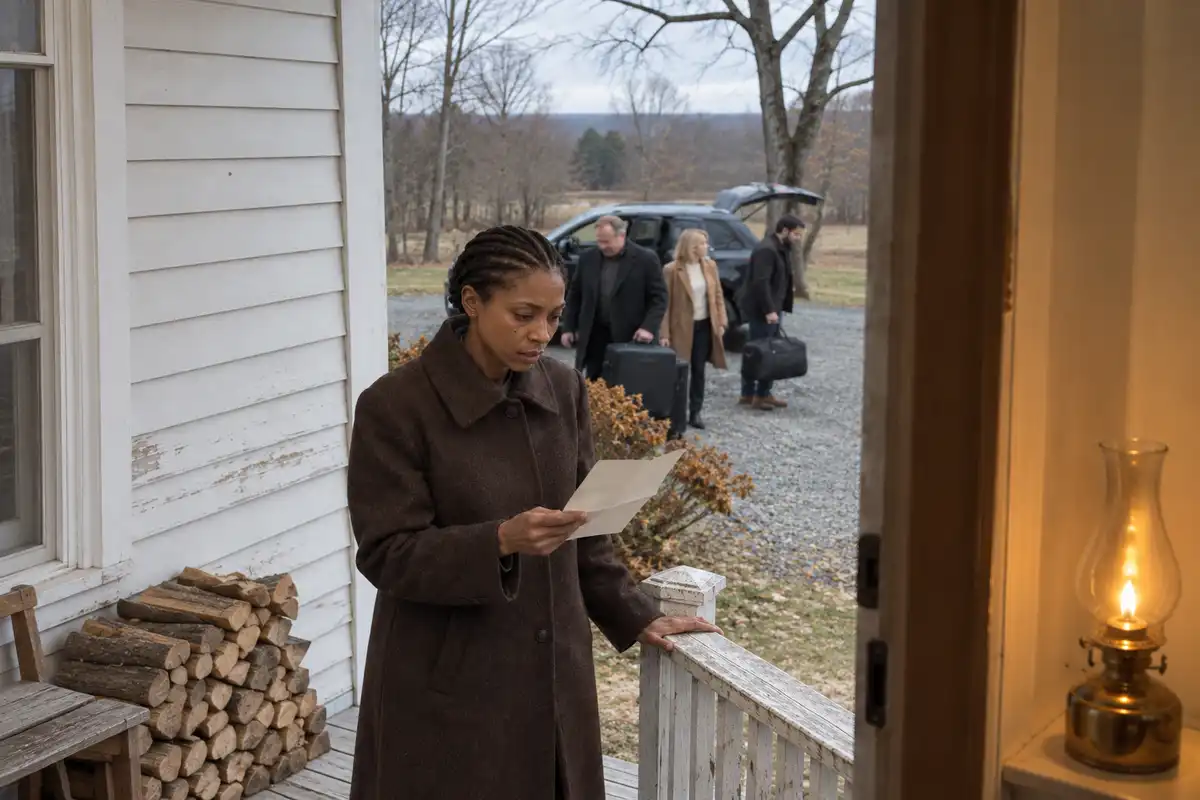
At 9:54 on the last Tuesday in October, Ruth Okafor parked Walter Brandt’s truck outside the law office and let it run.
She had eighteen minutes and no good reason to spend them inside.
The cab still smelled like him. Peppermint, sawdust, and the drugstore aftershave he bought three bottles at a time.
At 10:12 she shut off the engine and went in.
The other three were already there.
Dale was standing at the window with his coat on, the way a man stands when he means to be somewhere else by noon.
Lorna had taken the chair nearest the desk and turned it a few degrees toward the door.
Cody sat with his elbows on his knees, thumb moving across his phone.
Nobody asked her how the night had gone.
Nobody asked her anything.
At 10:15, Harold Whitmore put on his glasses and opened the folder.
“Thank you all for coming,” he said. “This won’t take long.”
He read the cash first.
After the hospital and the last four months of home care, sixty-one thousand dollars was left.
“To Dale, to Lorna, to Cody,” Harold read. “Equally.”
Ruth had not expected her name, and her name was not there.
Lorna’s shoulders came down half an inch.
Then Harold turned the page.
“The residence and the thirty-eight acres at forty-one eighty Bell Hollow Road,” he read, “shall pass to any child of mine.”
He let that sit for a second before he read the rest.
“Any child of mine who lives in the house continuously, from the first day of November through the last day of March next following my death.”
He read the conditions slowly, the way a man reads something he helped write.
Sleeping in the house every night.
Paying the cost of its heat.
No house sitters. No exceptions for travel.
No credit whatsoever for good intentions.
“And if nobody does it?” Cody said.
“Then the house and the thirty-eight acres go to the county historical society.”
Dale laughed first.
“November through March,” he said. “In that house.”
“That’s the condition.”
“Is that even legal?” Lorna said.
“It is.”
Cody did the arithmetic out loud, the way he did everything out loud. “That’s five months.”
“Five months,” Harold said.
Lorna checked the time on her phone and turned it face down again.
She had told Ruth twice already about the flight at 4:40.
Dale buttoned his coat.
He looked at Ruth for the first time since she had walked in, and he smiled, and his voice stayed perfectly friendly.
“You can keep the house. None of us want a museum with a leaky roof.”
Lorna made it worse by being kind about it.
“And you’ll have time, obviously. Until it sells.”
She put her hand flat on the desk, the way you do when you are being generous.
“Spring, at least.”
Driving over, Ruth had thought something in her would break when one of them finally said it out loud.
Nothing did.
What she thought about was the lamp.
The wick needed trimming, the kerosene can in the mudroom was down to a finger’s width, and the hardware store closed at four on Tuesdays.
Harold turned back a page.
“One question for the file,” he said.
“The heat at Bell Hollow. Who has been paying for it?”
The room waited for somebody else to know the answer.
“I have,” Ruth said.
“Since when?”
“Two winters.”
Dale gave the small wave a man gives a waiter he doesn’t need.
“She’s been living there. That isn’t the same as—”
“I’m not asking whether it’s the same,” Harold said. “I’m asking who paid.”
He wrote one line and closed the folder.
Then he took an envelope out of the drawer, sealed, with a date on the front in Walter’s handwriting.
He slid it across the desk to Ruth.
“From your father-in-law,” he said. “April, Ms. Brandt.”
“Okafor,” Lorna said.
Harold took out his pocket watch, looked at it, and put it back.
“Of course,” he said.
The house sat a half mile off the county road, at the end of a gravel drive Ruth had learned to take at fifteen miles an hour or lose a headlight to the ruts.
She had moved in on a Sunday in March, two years ago, eleven days after they buried Daniel.
Walter had had the stroke the month before that, and the plan was six weeks.
Six weeks turned into a shower chair she assembled on the kitchen floor, out of a box with instructions in four languages and one screw missing.
It turned into a pill chart on the refrigerator, under a magnet shaped like a walleye.
It turned into a code.
Two taps of his cane meant water.
Three meant the radio off.
One long scrape meant he had dropped something and did not want to say so.
She learned all of it in a month, the way a person learns a language when there is nobody around to translate.
His children called on Sundays.
Dale talked to her about the furnace.
Lorna talked to her about hospice brochures.
Cody talked to her about Cody.
Ada got off the bus at 3:40 and found her mother at the kitchen table with an unopened envelope in front of her.
“Did we lose the house?”
“No.”
“Did they?”
Ruth turned the envelope over. “Nobody’s lost anything yet.”
Dolores Pike came up the drive at four with the plow contract for the season, same as every October, and did not knock.
She was seventy-one and had farmed the other side of Bell Hollow for forty of those years.
“Well?”
“They laughed,” Ruth said.
“Course they did.”
Dolores did not ask whether Ruth had misheard it.
She did not ask whether Dale might have meant it some other way.
She sat down, pulled off her gloves, and set them on the table like a woman settling in.
“Five months,” she said, when Ruth had finished. “Sleeping in it.”
“That’s what it says.”
“You can’t inherit a house you won’t sleep in.”
“They might.”
Dolores made a sound in her throat.
“Dale Brandt hasn’t spent a February north of the interstate since he was nineteen,” she said.
Then she said, “I keep a book, you know.”
Ruth looked up.
“Every morning I plow, I write down whose drive I cleared and what was sitting in it.”
She tapped the table twice with one finger.
“Insurance man made me start it in ninety-eight. Two years of mornings up here, sugar.”
“And?”
“One truck.”
The letter came two days later, addressed to the Estate of Walter J. Brandt, with copies to everyone on Harold’s list.
A land agent for an aggregate company had been buying the hollow in pieces for three years.
They wanted the ridge.
The ridge came with the house.
Ruth read the number twice on the porch steps with her coat still on.
One million three hundred fifty thousand dollars.
For the museum with the leaky roof.
She folded the letter along its own crease and put it in the drawer with the propane receipts.
Then she went out to the woodpile, because the first of November was Saturday and the stove did not care what the land was worth.
Across town, at 4:26 that same afternoon, Dale Brandt sat in a grocery store parking lot with the engine off and the same letter open on his phone.
He had already called the land agent to make sure the number was real.
Then he called his sister.
“Did you read it?”
“I read it.”
“Five months,” he said.
“In that house.”
“In that house.”
That night Ruth went looking for the deed folder, because somebody was going to ask her for it and she wanted to be the one who knew where it was.
Walter’s desk gave up a drawer of carbon copies and rubber bands gone to powder.
Among them was a notary receipt, dated the second of February, the year before he died.
She sat back on her heels and remembered the morning that went with it.
He had made her drive him into town in weather that did not deserve the trip.
There had been three documents, a woman with a stamp, and a pen that skipped.
“What am I signing?”
“The insurance,” Walter said. “And the other thing.”
“What other thing?”
He had looked out at the parking lot for a while.
“It’s a birthday present,” he said. “It’s late.”
Her birthday was in January.
She had let it go, because he was tired that day, and because letting things go was cheaper than asking twice.
At 8:12 that night, headlights swung into the gravel drive.
She heard the car stop.
A door, and then a second door.
Ruth did not go to the window.
She lit the lamp first, the way he had taught her, so whoever was out there could find the way in.
Then she went to see which one of them had come.
The story continues in Part 2.