Nobody Is Driving Four Hours for Cake — Part 3
Four weeks later, Ernesto gave his children his answer at the same kitchen table. He did not sell the road. He told them what the shop is worth.
Rosa’s car was in the lot at seven the next morning.
Ernesto saw it when he came around the corner with his coffee, and he stopped walking for a second, and then he kept going.
She was sitting on the hood in yesterday’s clothes.
“You slept in the car.”
“I slept in the car.”
“There’s a motel in town.”
“I know there’s a motel in town.”
He unlocked the bay door and rolled it up, and the cold came out the way it does in October, and neither of them said anything for a while.
Then Rosa said, “I’m not here about the lot.”
“All right.”
“I mean it. I don’t want any of it.”
“All right.”
“Dad.”
He turned around.
“I left the coffee cake,” she said.
That was not what she meant, and they both knew it.
Ernesto looked at his youngest for a long moment.
A year and two months.
A card at Christmas, signed like a chart.
“I’m not going to say it’s fine,” he said.
Rosa’s face went the way faces go.
“Okay.”
“It isn’t fine.”
He set his coffee on the fender.
“You don’t get to drive up here one time and have it be fine.”
“I know.”
“Do you.”
“Yes.”
He picked the broom up out of the corner, where it had stood all month next to a surveyor’s stake with orange ribbon on it, and he held it out to her.
“Then start with Thursdays.”
Rosa took the broom.
The court papers came nine days later.
Ernesto read them standing at the counter, in the same place, with the same utility knife lying next to the envelope.
The language was gentle, which was the part that took the wind out of him.
Concern regarding the ability to manage financial affairs.
Advanced age.
Recent isolation following the death of a spouse.
His name typed out full, Ernesto Ramón Salas, the way it had only ever appeared on his marriage license and his father’s deed.
Tomás read it and got very quiet and then said one short thing in Spanish that Ernesto pretended not to hear.
“Is Danny on it?”
Ernesto turned to the last page.
One signature.
“No,” he said. “He isn’t.”
Danny called that night.
It was the first time in six years he had called without needing something.
“Pop, she sent it to me to sign.”
“I know.”
“I didn’t sign it.”
“I know that too.”
“She said it was to protect you.”
Danny’s voice cracked on the second word.
“She said it like it was a seatbelt.”
Ernesto sat down on the edge of the bed.
“Daniel.”
“Yeah.”
“When she asked you, in the kitchen. About the phone call.”
A long silence on the line.
“I looked at her,” Danny said. “I know I did.”
“You did.”
“I’m sorry.”
“You told me the truth with your face,” Ernesto said. “That’s still telling me.”
The evaluation was on a Tuesday, at 9:00, in a small office in the county building two floors above the recorder’s counter.
A doctor Ernesto had never met asked him questions for fifty minutes.
What year it was.
Who the president was.
What he would do if he smelled smoke.
How he paid his utilities, and from which account, and what he had paid for them last month, roughly.
Ernesto answered all of it.
Then the doctor asked him to name a date that was important to him, any date, and explain why.
“June fourteenth, 1969,” Ernesto said.
“And what is that?”
“That’s the day I married Alma Vega at St. Anne’s with forty-one dollars in my pocket.”
He looked at the window.
“I gave thirty of it to the priest.”
The doctor wrote something down and did not write anything else for a while.
The petition was withdrawn eleven days later, before it ever reached a judge.
Ernesto never learned whether it was withdrawn because of the evaluation or because a lawyer in Sacramento finally read the 1961 deed and understood who actually held the road.
He decided he did not need to know.
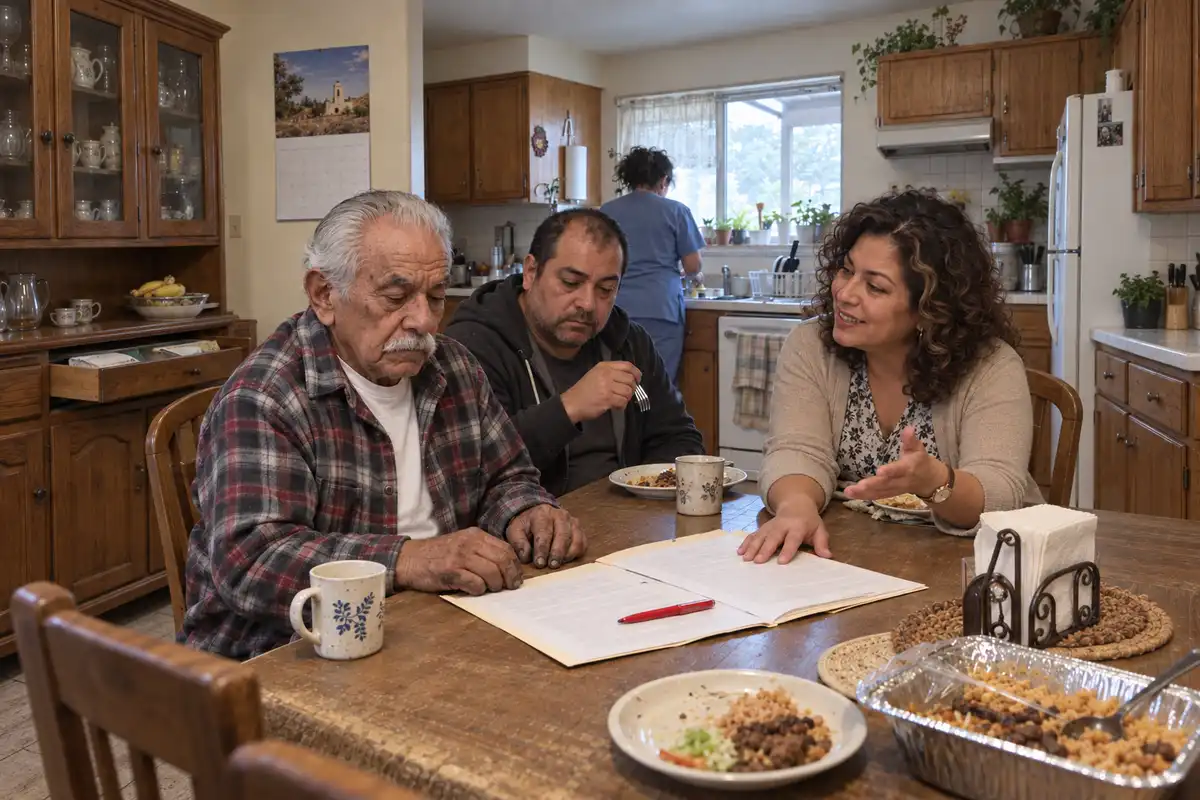
Four weeks from that Saturday, at one o’clock, they sat at the kitchen table.
Marisol came alone and sat with her hands in her lap like a woman in a waiting room.
Danny sat where he had always sat.
Rosa came straight from the shop and had grease on two knuckles and did not apologize for it.
Peter Ault stood in the doorway to the front room because Ernesto had asked him to come and then had not offered him a chair, and Ault had the sense not to ask for one.
On the table was a single sheet of paper and a pen.
“I’m not selling the front of the lot,” Ernesto said.
Nobody moved.
“They can’t build without a road across it, and I’m not giving them the road.”
He put two fingers on the paper.
“I’m renting it to them. Fifty years.”
Marisol’s head came up.
“An easement lease,” Ault said quietly, from the doorway.
“It’s — yes. It’s a real structure.”
“Every year they pay. Every year they keep paying.”
Ernesto looked at his oldest for the first time.
“And the day they stop, the road closes, and I still own my shop.”
“Dad, a lump sum today would—”
“Would be gone,” Ernesto said. “And so would the building.”
He slid the sheet an inch toward the middle of the table.
“The money goes into a trust. Four shares.”
“You three and the shop.”
Danny put a hand over his mouth.
“The shop keeps running as long as somebody’s running it,” Ernesto said. “When I’m done, it goes to whoever’s standing in it.”
He did not look at Tomás, who was outside in the bay with the compressor on, and who did not hear any of it that day.
“That’s not a bloodline thing,” he said. “That’s an attendance thing.”
Rosa laughed once, wetly, and put her hand over her eyes.
Marisol stayed after the others went out to the cars.
She stood on the far side of the kitchen with her keys already in her hand.
“You think I did it for money.”
“No,” Ernesto said. “I think you did it for the driver’s seat.”
She flinched harder at that than she would have at the other thing.
“I was trying to get ahead of a problem.”
“I wasn’t a problem, Mari. I was a Saturday.”
Marisol looked at the floor of the kitchen she had learned to walk in.
“Am I supposed to just leave now?”
“No.”
She looked up.
“You’re supposed to come back,” Ernesto said.
“Thursdays. Same as your sister.”
“That’s four hours.”
“I know exactly how far it is.”
Rosa came the first Thursday, and the second, and the one after that.
She worked three twelves at the hospital in Fresno and drove over on her off day, and slept in the back room on a cot from the Ramirez boys’ garage, and went back Friday morning.
By the sixth week she had her own coffee cup on the parts shelf.
By the ninth she could pull a brake drum without being told twice.
Eleven Thursdays in a row.
Danny started sending money.
Two hundred dollars at a time, from Phoenix, with no message attached.
The first one came in November and Ernesto called to tell him he did not have to.
“I know I don’t have to,” Danny said, and hung up, and sent another one in December.
Marisol came on the fourth Thursday.
She wore the wrong shoes for a shop floor and stayed twenty-two minutes and asked two questions about the truck, and one of them was a real question.
She came again the Thursday after that, in different shoes.
She has not missed one since, which Ernesto has noticed and has not mentioned, because he is his father’s son and that is not how his family says things.
Wendell Pryor comes by sometimes and stands in the bay and looks at the road.
He does not talk about the back forty anymore.
The new truck has a scratch down the passenger side now, and he has stopped washing it.
In March the Ford started.
It took eleven years, a rebuilt carburetor, and a girl who had learned to gap plugs in the dark.
On the fourth turn of the key it caught and held.
It idled rough and beautiful in the open bay.
Rosa was under the hood with a rag.
Tomás had his phone out, recording, yelling.
Delia had driven up from the diner because Tomás had texted her at four in the afternoon, and she came in carrying a cupcake on a paper plate, vanilla, with the frosting that comes out of a tube.
“You’re a year and five months late,” she said.
“I’ve been busy.”
Ernesto went out to the truck, and opened the passenger door, and reached into the glovebox past the registration and the church fan and forty years of receipts.
The little cellophane sleeve was where he had put it.
A blue 8.
A blue 0.
He set them in the cupcake on the hood of a truck that was finally running, in a shop his father built in 1961, at 5:10 in the afternoon.
Danny was on speakerphone from Phoenix.
Marisol’s car was coming up Old Mill Road; they could all hear it on the gravel.
Tomás lit the candles.
They sang it badly, in three different keys.
Rosa put her chin on her father’s shoulder.
“Four hours isn’t far,” she said.
“It is,” Ernesto said. “You just drive it anyway.”
And then he blew out the candles, and the shop went a little darker, and nobody left.
What would you have done if you were Ernesto — rented the road, or sold it and walked away?
This story is a work of fiction. Names, characters, places, and events are products of the imagination, and any resemblance to real people, living or dead, or to actual businesses or locations, is entirely coincidental.