The House Goes to Whoever Stays — Part 2
The money showed up two days after they laughed, and all three of them moved into the cold house. The widow just kept doing what she already did.
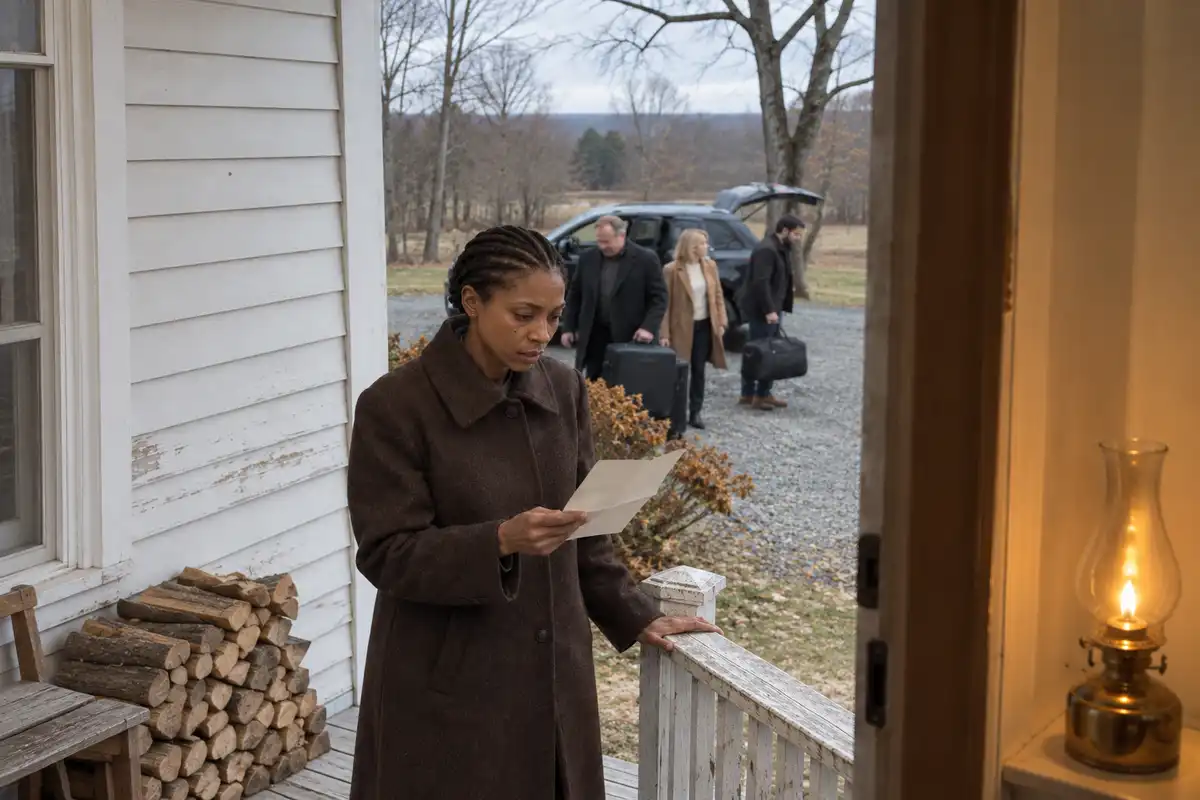
At 8:14, Ruth opened the door and found two of them on the porch.
Dale had a folder under his arm. Cody had a duffel bag and the look of a man who had been talked into something in the car.
“We’re not staying tonight,” Dale said.
“All right.”
“I need the deed folder.”
“It’s on the table.”
That stopped him for a second, because she had said it the way you say a thing that is already done.
He came in and stood over the folder without touching it.
“You knew about the letter.”
“It came here,” Ruth said. “This is where the mail comes.”
Cody looked around the kitchen like a man checking a house he had not seen since it belonged to somebody else.
He stopped at the window.
“That the old lamp?”
“It’s the old lamp.”
“Huh,” he said, and did not ask why it was lit.
Dale picked up the folder.
“We’ll be here Saturday,” he said. “Both of us. All three of us.”
“The first is Saturday,” Ruth said.
“I can read a calendar.”
At 7:40 on the first of November, Dale carried a suitcase and a laptop bag up the front steps and asked which bedroom had been his father’s.
“The south one,” Ruth said. “But the north bedroom is the only one that holds heat.”
He took the south one.
She did not say it twice.
That was the arrangement they fell into, and it lasted eleven weeks.
Ruth kept the kitchen and the stove and the mornings.
Dale kept the south bedroom, three calls a day on speaker, and a space between himself and everything else in the house.
He never once asked her where anything was. He looked for it, loudly, and then found it where it had always been.
Cody took the basement, because it was the only room where nobody would watch him.
In the second week of December, Ruth came in from the woodpile and found Dale walking the downstairs with a measuring tool and a notepad.
He pointed the little red light at the far wall of the front room and wrote the number down.
Walter’s barn coat was still on the hook by the door, where it had hung since October, and Dale had been standing under it for twenty minutes.
Ada came through with her boots in her hand.
“What are you doing?”
“Square footage,” he said, and pointed the light at the next wall.
Lorna arrived on the nineteenth at 11:52 at night, after a delay, and stayed two nights.
The second morning she stood in the kitchen with her coat already on.
“It’s not that I can’t,” she said. “It’s that it’s absurd to expect a person with a life to sit in a farmhouse for five months.”
“Nobody’s expecting you to,” Ruth said.
“Don’t do that.”
“Do what?”
“That thing where you agree with me and it comes out sideways.”
Kayla Voss started the following Monday.
She was twenty, took online classes at the community college, and had been hired, in Lorna’s words, to keep an eye on the property.
She slept in Lorna’s room, ate what Ruth cooked, and apologized about four times a day for existing.
At 1:40 in the morning on the second of December, the whole house went dark.
Cody had brought down a second space heater and run it off an extension cord with a lamp and a mini fridge.
Ruth found the breaker by feel, because she had found it by feel a hundred times.
When the lights came back, Cody was standing at the bottom of the stairs in a coat over a t-shirt.
“Don’t tell Dale.”
“He’s awake. His light’s on.”
“Then don’t agree with him about it.”
Three nights later Ruth heard him on the phone in the stairwell, telling somebody he’d have it by April, no problem, April at the latest.
The papers came out of the desk on a Sunday in December, when Cody went looking for the homeowner’s policy.
He carried the stack to the kitchen table and started dealing it out like cards.
A propane contract. Two years of heat bills with Ruth’s name on them.
A property tax envelope addressed to Ruth Brandt, opened, paid.
Cody held that one a second longer than the rest, then put it in the no pile.
Under it was a hospital intake form from the second stroke.
Somebody had filled in the emergency contact by hand.
Under relationship, in Walter’s slanted block capitals, it said DAUGHTER.
Lorna came in behind him and read it over his shoulder.
“He was on morphine for six weeks,” she said.
“He wrote it in February. He wasn’t on anything in February.”
“He was eighty-one, Cody.”
She took the form, squared the stack, and put the whole thing back in the drawer.
“He got confused about her,” Lorna said.
“That’s not a document. That’s a sad old man’s handwriting.”
Ruth was at the sink the entire time, four feet away, with her hands in the water.
She did not turn around.
She heard the drawer shut, and then she heard it open again, and she knew without looking that Lorna had gone back for the form.
Lorna found her on the back steps an hour later, salting the ice by the rail.
“I want to say something and I want you to hear it plain.”
“All right.”
“Two years is a long time to work on a man who owns four hundred acres of ridge.”
Ruth kept salting.
“Thirty-eight,” she said. “The rest went in eighty-nine.”
“You know what I mean.”
“I do.”
Ruth straightened up, and the bucket went down on the step between them.
“His blood pressure pill was at seven and the water pill was at eight, because if you gave them together he couldn’t make the bathroom in time and it humiliated him.”
Lorna’s mouth opened and did not do anything.
“That’s what two years looks like,” Ruth said. “You can have the ridge. I never asked anybody for the ridge.”
She picked the bucket back up.
“Watch the second step. It’s the one that ices.”
The ice came on the fourteenth of January.
By 9:05 that night the power was out from the county road all the way up the hollow.
Ruth had the stove going by then and the kettle on it.
She trimmed the wick, lit the lamp, and set it on the kitchen windowsill where it had always gone.
Dale stood in the doorway with his phone at eleven percent.
“Generator?”
“There’s no generator.”
“He had a generator.”
“He sold it in the spring,” Ruth said. “To pay for the ramp.”
Ada came down in two sweaters and sat on the woodbox, which was the warmest place in the house and always had been.
She watched her uncles carry their laptops around looking for a room that was different from the last room.
Then she asked the question that had been sitting in the house since October.
“If Grandpa wanted them here, why didn’t he ever just ask them to come?”
Nobody answered her.
Ruth put a cup in the girl’s hands and said the kettle would be ready again in ten minutes.
At 6:20 the next morning, Dolores Pike came up the drive with the blade down.
She cleared to the turnaround, backed out, and wrote in a spiral notebook on the seat beside her, the way she had since 1998.
Bell Hollow, 4180. One truck. Two cars.
She did it again on the sixteenth.
On the seventeenth she wrote: one truck.
Dale left at 4:15 in the afternoon on the sixteenth.
The power had been out for forty-three hours. His south bedroom was thirty-nine degrees and his phone was dead and there was a hotel by the interstate with a working elevator.
He stood in the kitchen with his bag and explained it to her, which was the part Ruth remembered later.
He did not have to explain anything to her. She was not the one keeping score.
“It’s one night,” he said.
“Seventy-six nights I’ve been in that room. One night doesn’t move anything.”
“All right.”
“You think it does.”
“I think it’s cold,” Ruth said, “and you’re a grown man.”
He was gone eleven minutes later.
At 2:07 in the morning on the seventeenth, Cody checked into the same hotel, eight rooms down, and paid with the card that still worked.
Neither of them knew about the other until the receipts came out in March.
The power came back on the eighteenth.
Dale came back on the eighteenth too, with a generator in the bed of a rented truck, two months too late to matter.
He set it up on the back porch and ran it for six hours a day and stopped speaking to anybody at breakfast.
Lorna started calling twice a week to ask Kayla questions with no right answers.
How does the house look. Is the driveway clear. Is anyone sleeping in my room.
On the twenty-second of February, Kayla knocked on the kitchen doorframe with an envelope in her hand.
“Mrs. Brandt’s lawyer sent a form,” she said.
“It’s about residence. It wants me to write down who lived here and when.”
“Then write it down,” Ruth said.
“She told me what to put.”
Kayla’s ears had gone red.
“She said to put that I’m family.”
Ruth dried her hands and took a long time doing it.
“Are you?”
“No, ma’am.”
“Then you’ve got your answer, and you didn’t need me for it.”
“She’ll fire me.”
“Probably.”
Ruth sat down across from her.
“You’re twenty years old and somebody’s asking you to put your name on something that isn’t true. That follows a person.”
Kayla mailed the form herself, from town, on the twenty-third.
She wrote what was true.
Lorna called that night and was still calling at eleven.
Ruth did not tell Dale, and she did not tell Cody.
When Dolores heard about it at the feed store and said it served that woman right, Ruth said the girl had classes in the fall.
“Leave her out of the rest of it,” she said.
The land agent’s second letter came on the first of March.
It was two paragraphs long and perfectly polite.
The company needed clear title by the fifteenth of April. After that the offer went back to the county and the hollow got priced without the ridge.
Dale read it on the porch with his coat open in twenty-degree air.
Then he called Lorna, and then he called Cody, and by that evening all three of them knew what the other two had done.
Cody had a hotel receipt with his brother’s arrival time on it.
Dale had a form from a twenty-year-old girl with his sister’s name in it.
Lorna had nothing, and said the most.
Ruth listened to forty minutes of it through the kitchen wall and kept peeling potatoes.
When it went quiet she carried the bowl to the stove, because dinner was still at six whatever else the day had been.
At 10:15 on the twentieth of March, a letter from Harold Whitmore arrived at the house and at three other addresses.
It said the office, the thirty-first, four o’clock. It said to bring proof of residence.
Cody called the office from the driveway with his voice already up.
Ruth heard his half of it from the porch.
“Four of us. There’s three of us, Harold.”
Then there was a pause, and Cody stopped walking.
He said, “What do you mean, four?”
Ruth stood very still on the top step with a dish towel in her hand.
She was thinking about a February morning, a pen that skipped, and a birthday present that was late.
The story continues in Part 3.