The House Goes to Whoever Stays — Part 3
Four o'clock on the last day of March, the attorney opened a box instead of a folder. The will said any child of his. There were three of them, he said.
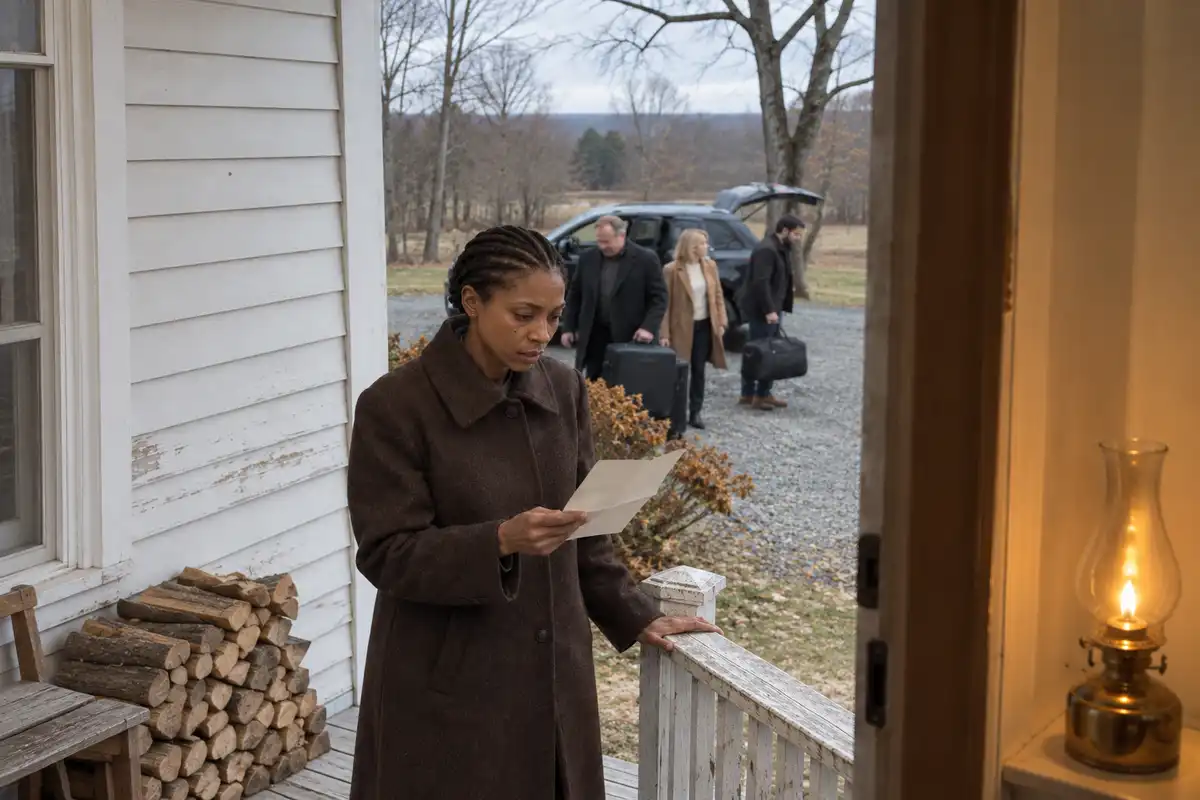
At 3:52 on the thirty-first of March, Ruth sat down in the same chair by the window, with the envelope in her bag and the date on it not yet come.
Dale had a folder. Lorna had a lawyer of her own on the phone in the hallway.
Cody had nothing but a hotel receipt he had already decided to lie about.
At 4:00, Harold Whitmore came in and set a box on the desk instead of a folder.
He did not sit down right away.
“Before we start, I’ll say one thing, because it’s fair to say it.”
He took off his glasses.
“I’ve known what’s in this box since February of the year before last. Your father instructed me to say nothing until today, and I didn’t.”
“That’s convenient,” Lorna said.
“It’s a client’s instruction,” Harold said. “It’s the whole job.”
He went through the residence first.
Dale, one hundred and forty-six nights, less one.
“Which one?” Harold said.
“The sixteenth of January.”
“Where?”
Dale looked at the window a long time.
“A hotel on the interstate.”
“Thank you.” Harold wrote it down.
“Cody. The seventeenth of January?”
“I was at the house.”
Harold slid a photocopy across the desk without any particular expression.
“Room two-eleven. Two in the morning. Your card.”
Cody sat back and laughed once, at nothing.
Lorna’s turn took eleven seconds, because Kayla Voss had written three sentences and signed them.
“So none of us did it,” Dale said. “Fine. It goes to the historical society and we all look like idiots.”
“That would be the case,” Harold said, “if the clause said what you think it says.”
He opened the box.
“Any child of mine.”
“There are three of us,” Lorna said.
Harold put a certified copy on the desk and turned it so it faced Ruth.
“Mrs. Okafor,” he said. “Did you bring your decree?”
“My what?”
“That’s what I thought.”
He said the rest of it slowly, the way he had read the will in October.
Marchand County Probate Court. An adoption of an adult. Filed the second of February, the year before Walter Brandt died.
Petitioner, Walter James Brandt.
Adoptee, Ruth Adaeze Okafor.
Ruth read her own middle name upside down on a court document and felt the floor go a little further away.
He had asked her how to spell it twice that winter. She had thought he was being polite.
“He signed it in my office,” Harold said.
“She signed it in my office. There was a notary and a pen that didn’t work.”
The room did four things at once.
Lorna took off her glasses and pressed the heels of her hands against her eyes.
Cody said, “February,” to the ceiling, like he was checking an answer he had already gotten wrong once.
Dale reached for the document and then stopped his own hand halfway, because it was not his.
Ruth sat very still and did not touch it either.
“I didn’t know,” she said.
“I’m aware.”
“He told me it was a birthday present.”
“It was late,” Harold said. “He told me that too.”
Dale found his voice in the place men keep it.
“She was his son’s wife. She’s staff.”
“She’s been in that house two years cooking his meals, and now she’s a daughter?”
“She’s been in that house two years cooking his meals,” Harold said, “and he noticed.”
“He was eighty-one.”
“He was.” Harold took a single sheet out of the box.
“There’s a letter from his physician, dated the thirtieth of January that year. On capacity.”
He set it down where all three of them could see it.
“He asked for it himself. He said somebody would bring it up.”
Lorna put her glasses back on and did not say the word morphine.
Then Harold went through the residence a second time.
Two winters of heat bills in Ruth’s name, and this one.
Property taxes, paid, three years.
A spiral notebook, photocopied at the page, in handwriting that slanted uphill.
“Mrs. Pike is in the waiting room,” Harold said. “She came in the plow truck, in case anyone would like to ask her anything.”
Nobody did.
“The house and the thirty-eight acres at forty-one eighty Bell Hollow Road,” Harold said, “pass to Ruth Brandt.”
He looked up.
“Okafor,” he said. “If she prefers. The court took both.”
Lorna stood up and put her coat over her arm and looked at Ruth for a second and a half.
“I hope you understand how this looks,” she said.
“I do,” Ruth said.
It was the last thing either of them ever said to the other, and neither of them knew it at the time.
Dale was the first one out.
Ruth watched through the window as he crossed the lot, phone already at his ear, and she knew who he was calling and she knew what the man was going to tell him.
Clear title by the fifteenth of April, or the hollow gets priced without the ridge.
The ridge was not for sale.
At 4:41 she came out to the parking lot and he was still standing beside his car with the phone down at his side.
“You’ll sell it in two years,” he said. “That roof alone.”
“Maybe.”
“You will. You’ll get one February in that house by yourself and you’ll call him.”
Ruth found her keys.
“I’ve had two,” she said.
Dolores was waiting by the plow truck with the engine running and the heater on for nobody.
She looked at Ruth’s face and then at Dale’s back going around the building.
“Told you,” she said.
“You did.”
“Get in. You’re not driving home crying in that truck of his.”
“I’m not crying.”
“Then get in anyway. I’ve got the good defroster.”
She opened the envelope the next morning, the first of April, at the kitchen table, with the stove going.
It was one page, both sides, in the handwriting that slanted uphill.
He wrote that a land man had been walking the ridge since before Daniel died, and that he had known for three years the money would show up eventually.
He wrote that he had wanted to know who would be in the house before it did.
He wrote: They’ll come when it’s worth something. They always come when it’s worth something.
Then, further down, in smaller letters, one line about the lamp.
You keep it lit. I watched you do it the first winter when you thought I was asleep.
And at the end, no advice, no instructions.
Just: I put your name where it belonged. Do what you want with the rest of it.
Ruth folded it, put it back in the envelope, and went out to check the water line at the road, because it was April in that county and a thing could still freeze.
In the second week of April, Dolores Pike leased the hay ground for a dollar a year and brought the dollar in cash so it would be a real transaction.
She put it on the table under the sugar bowl.
“Fifty-one more of these and you can fix the porch,” she said.
In June, Ada painted the kitchen window frame, badly, in a green she chose herself.
She worked around the lamp instead of moving it, so there is a clean ring in the paint where it sits.
In September, Cody came up the drive and did not come inside.
He stood on the bottom step and asked whether there were any photographs of his mother left in the house.
Ruth brought out the shoebox and he went through it on the porch for an hour and took four.
“He ever say anything about me?” Cody asked, at the end. “That winter.”
Ruth thought about it honestly, which took a moment.
“He asked if you’d eaten.”
Cody nodded at the floorboards for a while.
He did not ask for anything else, and he did not apologize, and he was gone before dinner.
In November the roofers came.
It cost eleven thousand dollars, and it was paid for with the hay lease, the insurance settlement on the barn, and two years of a nurse’s aide wage Ruth had never once spent on herself.
Walter’s barn coat came off the hook that month, because Ada had finally grown into the shoulders.
Ruth moved her things into the north bedroom the week the roof was finished.
It had been his, and then it had been nobody’s, and it was the only room in the house that held heat.
The south bedroom got the extra quilts and the door closed, the way you close a room you are not using yet.
On a Tuesday near the end of that November, a car slowed on the county road at the foot of the drive.
It sat there with its blinker on for the better part of a minute.
Ruth saw it from the kitchen and did not go out.
The blinker went off, and the car went on toward town, and that was the last time Dale Brandt came that close to the house.
It was the first winter in ten years that the museum did not have a leaky roof.
Dolores had come by in October with the plow contract, same as every October, and she had not knocked then either.
She stood in the door with her gloves already off.
“Cold one coming.”
“Let it come,” Ruth said.
On the first hard night of December, the power held and the stove ran and the north bedroom was warm by eight.
Ruth trimmed the wick anyway.
She set the lamp on the sill in the ring of green paint, and lit it, and went to bed.
From the county road, a half mile off, you could see one window burning at the top of the hollow.
Anybody out there could find the way in.
What would you have done if you were Ruth — stayed all those winters, or walked away the first time they laughed?
This story is a work of fiction. Names, characters, places, and events are products of the imagination, and any resemblance to real persons, living or dead, or to actual events is entirely coincidental.