Farms Need a Man's Name on the Deed — Part 2
The lawyer set his glasses down and asked one plain question about the last ten years. Nobody at that table had thought to ask it before that morning.
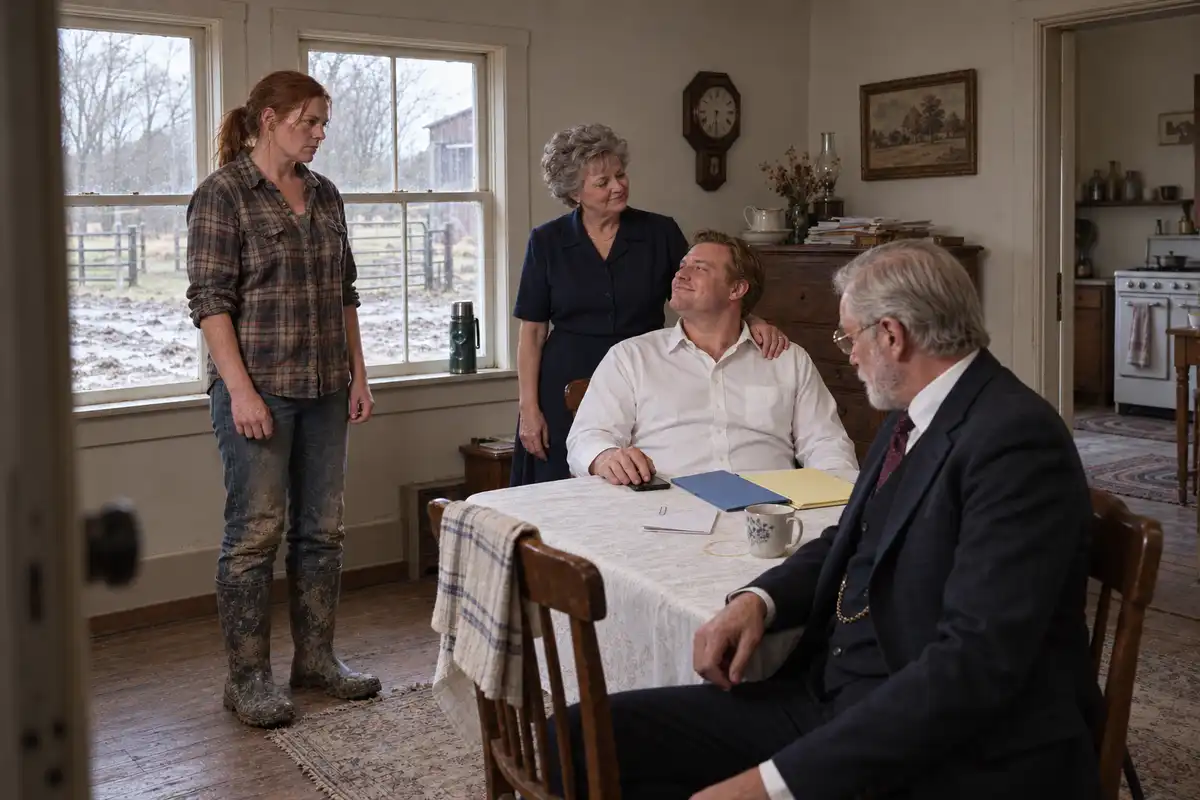
At 9:52 a gray sedan came up the lane and parked square with the porch steps.
Harold Whitmore had been doing this family’s paperwork since before Megan could read.
He got out with a soft leather case under his arm and stopped for a second at the west gate.
He looked at the orange twine holding it shut.
He did not say anything about it.
Darlene met him at the door with the coffee already poured and the good cups down off the high shelf.
The dining room had the cloth on it that came out for funerals and Easter.
Darlene put her hand on the back of her father-in-law’s old chair at the head of the table, which had been Ray’s chair for thirty-one years.
“Sit up here, Wade, where everybody can hear you.”
Wade sat.
Megan took the chair by the window, nearest the door to the yard, because she had a truck coming at a quarter past.
Coco stayed out on the porch with her tablet, and the screen door hung open two inches behind her, the way it had since the spring the frame swelled.
Harold laid three things on the cloth.
The will, in a blue folder.
A yellow legal pad.
A thin envelope, sealed, with a paper clip on one corner.
He set the envelope off to his left, beside the sugar bowl, and left it there.
“What’s that one?” Darlene said.
“That one comes later.”
“Later than what?”
Harold took his glasses out of his shirt pocket and put them on.
“Depends on the morning.”
At 10:00 he started to read, in the slow flat voice he used for this, which gave nothing away.
The truck and the tools to Wade.
The guns split between them, oldest first.
The certificates and the checking account to Darlene, and the household goods, and the right to live in the house and the acre it sat on for the rest of her life, with the taxes paid out of the estate.
Darlene’s shoulders came down an inch.
She got up in the middle of it and filled Harold’s cup before he asked for it.
Wade’s phone lay face down by his plate and buzzed twice against the table.
He turned it over, looked, turned it back.
At 10:18 the hauler’s truck came down the lane and the air brakes let go out by the milk house.
Megan stood up.
“Sit down,” Darlene said. “He’s reading.”
“He needs a signature.”
“Wade can go sign it.”
Megan looked at her brother.
Her brother looked at the folder in front of Harold.
“He doesn’t know where the sheet is,” Megan said, and went out.
She was back at 10:24 with the pink copy folded into her shirt pocket.
Harold made one short note on the legal pad and kept reading.
At 10:52 he came to the end of a page and stopped.
He took his glasses off and set them on the cloth.
“Now we’re at the residuary,” he said. “That’s the farm itself.”
“Three hundred forty acres, the buildings, the herd, the equipment, and the milk base.”
Darlene sat forward.
Harold read it the way it was written, without hurrying any of it.
“I give the whole of the farm operation to whichever of my children has been the operator of record of this place, continuously, for the ten years before my death.”
“As shown by the county farm office and by the daily records kept here.”
He turned the page.
“On the condition that it stays in operation for five years from the day I die.”
“If it is sold, or leased out of production, before those five years are up, the land goes to the county agricultural land trust, and whoever sold it takes nothing out of it.”
The clock over the sideboard went on with what it was doing.
“Well,” Darlene said. “That’s Wade.”
“Is it,” Harold said.
It was not a question the way he said it.
He put his glasses back on and looked at his legal pad.
“Who does the county office have listed as the operator on this place?”
“Wade’s been managing things from the city for years now.”
“I’m asking who’s listed.”
Darlene’s mouth closed.
Harold turned to Wade, and his voice did not change at all.
“Son. What year did the county last update the operator on this farm?”
“I’d have to look at that.”
“Whose name is on the operating note at the bank?”
Wade looked at his mother.
“Whose name does the hauler sign against when he pulls the tank?”
Nobody said anything.
Megan took the pink copy out of her shirt pocket, unfolded it once, and laid it in the middle of the good cloth.
“That’s from 10:21 this morning,” she said.
Then she got up and went out to the milk house.
She came back at 11:10 with the books in a feed sack and set them down in two stacks of five.
Blue covers. Years on the spines in feed-store marker.
The water stain on 2019 had gone brown with age.
Darlene put her fingers on the collar of her blouse and left them there.
Wade opened the top book, read maybe four lines of it, and shut it again.
Harold reached into his case and drew out a single sheet and slid it across the cloth to the middle, next to the hauler slip.
“I asked the county office for this on Thursday,” he said.
One page. One line on it that mattered.
Operator of record, Holt Dairy, Megan Holt.
March of 2016 to present.
From the doorway Coco started counting the notebooks out loud.
“One, two, three, four —”
“Coco,” Wade said.
She got to ten anyway.
“You knew,” Darlene said.
“I knew what was in my books.”
Megan kept her hands in her lap.
“I didn’t know what was in his.”
“Your father wasn’t right, those last two years.”
“He signed this three years ago,” Harold said, “in front of two witnesses, in my front office.”
“He was right enough to drive himself home afterward, and he did.”
Darlene turned in her chair and looked at the window instead of at anybody.
“So what happens to me.”
Harold went back three pages without any trouble finding it.
“You have the house, the acre, the garden, and the taxes paid. For as long as you want it.”
“In my own house.”
“In your own house, ma’am.”
Darlene was quiet for a while.
“And the deed,” she said.
“The deed will have your daughter’s name on it.”
Megan did not look up from her hands.
Out the window, past her mother’s shoulder, the green thermos was still sitting on the fence post.
The second cup would be stone cold by now.
She thought about that instead, and it got her through the next ten minutes.
Wade had not said one word since the question about the hauler.
He was reading the tablecloth.
She had waited ten years to hear a sentence like that one, and now that it was on the table she found she did not need anybody to see her face while it landed.
Harold stayed for the paperwork, and Darlene put out ham and bread because that was what you did when a lawyer was at the table past noon.
Nobody ate much.
At 1:34 Wade’s phone went off for the fifth time since ten o’clock, and this time he took it and walked out to the porch.
The screen door came to rest two inches short of the frame, the way it always did.
“No. No, listen —”
“It’s not going to be Friday.”
A pause that went on.
“Because I don’t own it.”
Darlene set her fork down.
“I know what you already paid me.”
“I’ll get it back to you.”
“I said I’ll get it back to you.”
Coco looked up from the tablet.
“Is Daddy in trouble?”
Harold took out his pocket watch, looked at it, and put it away again without saying what time it was.
Wade came back in and sat down.
Not at the head of the table.
“Before I go,” Harold said.
He reached over to the sugar bowl and picked up the thin envelope with the paper clip on it.
He set it in the middle of the cloth, on top of the hauler slip and the county sheet.
“Your father left this with me the same afternoon your sister signed those books.”
“He told me to read it out loud only if it came out this way.”
“What do you mean, this way,” Darlene said.
Harold ran his thumb under the flap and broke the seal.
Megan looked at the envelope and did the arithmetic on it.
Three years ago.
Before the leg, before the hospital, before any of it.
Her father had known exactly what this table would sound like.
And he had left an answer sitting in a drawer in town, waiting.
The story continues in Part 3.