Farms Need a Man's Name on the Deed — Part 3
Her father left a second envelope with instructions to read it only if the morning went this way. It was written in pencil, three years early.
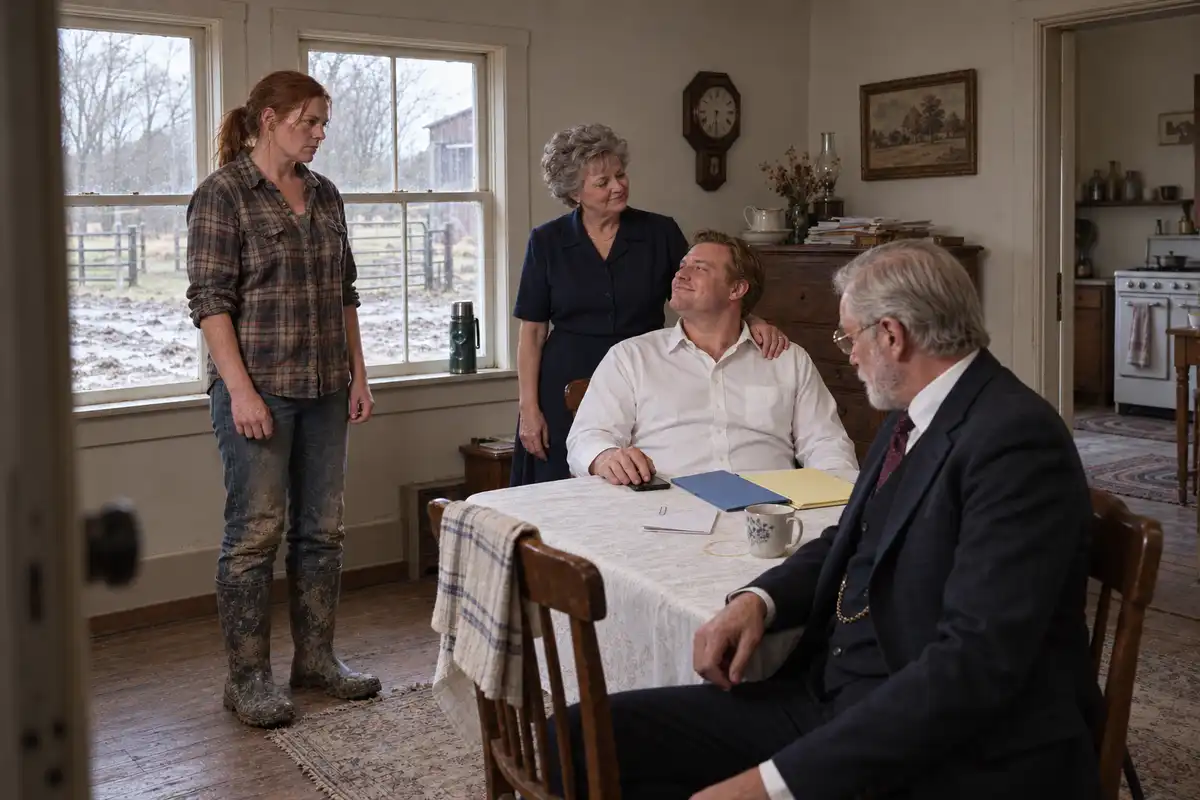
Harold took out a single sheet of lined paper, folded in three, and opened it flat on the tablecloth.
It was written in pencil.
“He wrote this himself,” Harold said. “I’ll read it the way he has it.”
Then he read it out loud, and he did not soften any of it.
Darlene.
I was in the milk house on the second of March when you told Ruthie that a farm needs a man’s name on the deed.
The window was open.
You said it again at Easter, and at the table when Wade brought that girl home, and I heard you both times.
I should have said something the first time.
I did not, and that is mine to carry, not Megan’s.
Wade.
You were never going to keep this place, son.
That is not a sin and I never held it against you.
But do not take it off your sister, and do not let anybody tell you that you built something you have not seen the inside of in nine years.
Meg.
I bought the hinge for the west gate in the spring and it is on the bench.
I kept meaning to put it on.
I kept meaning to do a lot of things out loud.
You wrote it down for ten years and you never once asked me what I was going to do with any of it.
That is how I knew.
Harold folded the paper along its own creases and set it down.
Nobody moved for a while.
Darlene got up and carried two plates to the sink that did not need carrying.
“He was sick when he wrote that,” she said, with the water running.
“He wrote it three years ago,” Harold said. “You were at your sister’s in Bowling Green that week.”
The water kept running.
Wade waited until Harold was packing the folder away.
“The five years,” he said.
“What if it can’t carry itself. Hypothetically.”
“Then the land goes to the trust and nobody in this room sees a dollar of it.”
“That’s not what he’d want.”
Harold closed the case and clicked it shut.
“It’s what he wrote.”
Harold left at 2:20 and Wade walked him out.
Megan watched them from the window by the sink.
Her brother talked with his hands the whole way down the steps, and Harold stood still and let him get to the end of it.
Then Harold said one thing, maybe two sentences’ worth, and put his hat on, and got in the car.
Wade stood in the drive until the sedan was out on the road.
He did not come back in.
His truck went down the lane at 2:36, and it was clean going out the same way it had come in.
She signed for it in Harold’s front office on the first Monday of November, in the same chair.
He slid the last page across and watched her write the date under her name without being told to.
“Your father sat where you’re sitting and asked me whether a man could leave a farm to the one who’d earned it instead of the one who expected it,” Harold said.
“I told him he could, if he was willing to write down what earning it meant.”
Then he put the cap back on his pen and asked after the herd, and that was all he ever said to her about any of it.
The deed itself came in the mail two weeks later, on a Tuesday.
Megan read her own name on it twice in the driveway with the flag still up on the box.
Then she carried it to the milk house and put it on the shelf above the sink, at the end of the row of blue notebooks, where the next one would have gone.
She did not frame it.
She did not take a picture of it.
Her mother never asked to see it, and Megan never offered.
That sentence about the deed was not said again in that kitchen, by anybody, ever.
The first milk check with her name printed across the top came the second week of December.
She stood in the parlor with it while the vacuum pump ran and read the name four times.
Then she wrote the number in the book, in the column where it always went, and got back to work.
Thanksgiving, her mother ironed a white shirt on Wednesday night and hung it on the door of the front room.
Wade called Thursday morning and said the weather looked bad through the pass.
The weather was fine.
The shirt hung on that door until the second week of December, and then it went back in the closet, and Darlene never said one word about it.
Coco called on a Sunday in January and asked to talk to Aunt Megan.
Darlene answered the phone and stood there holding it out, not saying anything, until Megan came and took it.
“Did the calves come yet?”
“Two of them. There’s a red one.”
“Dad says a red one is worth less.”
“Your dad’s wrong about that,” Megan said. “Come see her at Easter.”
She heard Wade’s voice somewhere behind the girl, too far off to make out.
Coco called again the last Sunday of the month, and the Sunday after that, and after a while it was just a thing that happened on Sundays.
Ruthie came for her eggs in February with snow on the shoulders of her coat.
“They’re saying fifteen thousand at the co-op,” she said.
“I heard.”
“Took a deposit on ground he didn’t own and spent a piece of it.”
Ruthie put her envelope on the step.
“Merle’s boy heard it from the man himself, so it’s around.”
Megan handed over four dozen and did not add anything to it.
“You’re not going to say a word about him, are you.”
“No.”
Ruthie nodded like that was the answer she’d come up the lane for.
“Your daddy’d hate that it went this way,” she said.
“He’d have liked it too, though.”
“Both at once. That’s how he was.”
The farm stayed a farm.
That was the whole condition and it was the easy part.
Eighty-one milking came down to seventy-six over the winter and came back up to eighty-eight by May.
Megan took the hired man’s hours up and her own hours down, by about forty minutes a day, which is not nothing when it is the same forty minutes every day.
She started sitting down to eat supper.
She got her hair cut in town for the first time since the funeral, and the woman who cut it asked whether she’d come into some money.
“I came into some work,” Megan said.
The woman laughed at that like it was a joke, and Megan let her.
Her mother cooked for two and set it on the table at six and they ate mostly in quiet, and that was the shape it took.
Darlene kept the house, the acre, and the garden.
She put in tomatoes in the spring the way she always had, and canned them in the fall the way she always had, in a kitchen on a place that belonged to her daughter.
She never said she was sorry, and Megan never waited for it.
The second Saturday in April, Megan went into the shop and took the paper bag off the bench.
The hinge was still in it, with the receipt folded underneath, six years old and gone soft.
She took it out to the west gate at 4:41 in the morning with the yard light on and a pair of vise grips in her back pocket.
The old hinge came off in two pieces.
The new one took her eleven minutes and one trip back for a shorter bolt.
When it was on, she swung the gate and let go of it.
It came around and dropped into the latch on its own, the way it was built to, and stayed there.
She stood and looked at that for longer than it deserved.
Then she untied the orange twine, wound it around her fingers into a coil, and put it in her coat pocket.
The thermos was on the fence post where it always was.
She poured the first cup and drank it standing up, and the cows came up the lane behind her without being asked, because it was that time.
Then she poured the second one.
She drank that one too.
The light was starting behind the heifer lot, and the gate was shut, and it was going to be a long day, and she had the whole of it.
Would you have kept writing it down, all those years, with nobody in the house ever asking to see it?
This story is a work of fiction. The names, characters, places, and events are products of the imagination, and any resemblance to real people, living or dead, is coincidental.