Some Women Are Just Help — Part 2
At 4:38 on Christmas Day, Lorraine said the cruelest thing she had ever said out loud, and the quiet guest folded her napkin and spoke.
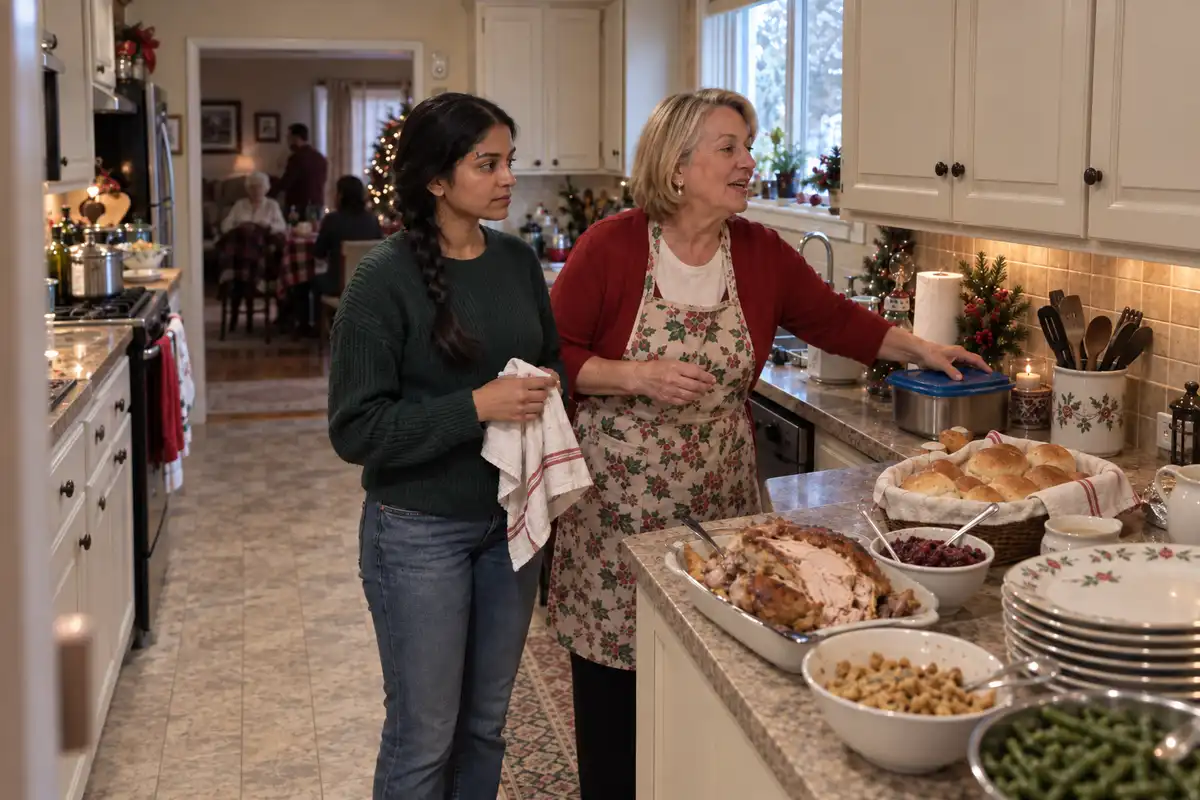
At 4:05 they finally sat down, and Lorraine decided to go around the table.
She did this every year. It was not an introduction. It was an inventory.
“That’s my mother, Ruth. Ninety percent deaf and a hundred percent opinion.”
Ruth looked at her.
“Hannah’s in human resources, at the college. Very good at it. And that’s Maya, who is going to be a veterinarian.”
“A horse doctor,” Maya said.
“A veterinarian.”
Lorraine turned her wrist toward Adam.
“And this is my son. Adam.”
“He’s at Corliss-Bray — eleven years now, started in the warehouse, if you can believe it. They’re making him regional director.”
“They haven’t,” Adam said.
“They’re making him regional director,” Lorraine said again, to Eleanor.
Down at the cold end of the table, Eleanor Voss set her water glass on the cloth.
Her hand stayed on it.
She had been lifting it. She did not lift it.
Ruth, who had not said anything for an hour, watched that hand and then looked at Eleanor’s face, and then looked at her plate.
“And Priya,” Lorraine said, “helps at the hospital.”
The oven ticked as it cooled.
“Helps,” Eleanor said.
“Mm-hmm.”
“In what capacity?”
Priya put down the serving spoon.
“I’m a nurse. Cardiac step-down.”
Lorraine laughed and reached over to pat the back of Priya’s hand.
“That’s what I said, sugar.”
At 4:22 the rolls came around the second time, and Lorraine noticed the gravy boat was low.
She did not ask Adam, who was closest to the kitchen.
“Priya, would you.”
Priya stood up. It took a moment, because she had to move her chair back past Maya’s, which was still wedged in where it did not belong.
She went into the kitchen, warmed the gravy, and came back with it, and by then the conversation had moved on to a cousin in Tampa.
She set the gravy boat down and stayed standing, because Lorraine had already lifted her plate an inch off the table, holding it out without looking, the way you hold something out to a person who is there for that.
Priya took the plate.
Maya put down her fork.
“Why does Aunt Priya eat standing up?”
Nobody answered.
“She hasn’t sat down the whole time. Why is she —”
“Maya.” Adam did not look up. “Finish your food.”
Hannah reached over and cut her daughter’s turkey into smaller pieces that did not need to be smaller.
Priya carried the plate to the kitchen.
She scraped it, set it in the sink, and ran the water for three seconds.
In the window over the sink she could see the whole table behind her, everybody’s back, and her own face floating in the middle of it.
She turned the water off.
She went back in.
At 4:38, Priya came around the table with the platter, and Lorraine took it out of her hands.
She took it the way you take something from a caterer.
Then she turned to Eleanor, who was the only stranger at the table, the only new audience she had been given all year, and she said it in the exact voice she had used for the roads and the brine.
“You have to train them early, or they never learn. Some women are wives, dear.”
She set the platter down.
“Some are just help.”
A log dropped in the fireplace in the other room.
Ruth put her fork on her plate. She did not put it down so much as retire it.
Hannah reached for her wine and found it already in her hand.
Maya looked at her mother, then at Priya, waiting for one of them to say the thing that adults were supposed to say.
Adam looked at his plate.
He kept looking at it.
Priya took the platter back from where Lorraine had set it, turned it a quarter turn so the carving side faced the table, and sat down.
That was all she did.
At the end of the table, Eleanor Voss folded her napkin in half, and then in half again, and laid it beside her plate.
“May I say something.”
It was not a question and she did not wait.
“I was in that hospital for eleven days in March. I’m seventy-four and I live alone and there is nobody to call, which I’m not saying for sympathy, I’m saying so you understand the arithmetic.”
Her voice was unhurried. She might have been reading a grocery list.
“Three of those nights I could not get air. Not the way you mean when you say that. The real way.”
“Ma’am —” Lorraine started.
“All three nights, the person who sat with me is the one you just sent to the kitchen with your plate.”
Nobody moved.
“She sat on the floor by the bed the second night because they took the chair to another room. She talked me down. She got it wrong the first time and she stayed and got it right.”
Eleanor turned her head.
Not to Lorraine.
“You’ve been quiet, Mr. Whitfield.”
Adam’s head came up.
It was the first time anyone had used his last name at that table in his life.
Something about the way she said it went through him before he understood why.
Flat and professional, the way a name gets said in a room where decisions are made.
Then he heard the rest of it.
Voss.
The color went out of his face in stages, like a light on a dimmer.
Eleanor watched him figure it out and did not help him.
“I’m sorry,” Adam said. “I didn’t catch your —”
“You didn’t ask for it.”
Lorraine got up.
It was the worst thing she could have done and she did it fast.
“Well — my goodness. We joke in this family.”
She laughed, and nobody joined her.
“That’s all that was. We have always joked.”
“Sit down, Lorraine,” Ruth said.
The whole table turned.
Ruth had not put a full sentence into a Christmas dinner since the year they buried her husband.
“She carried your pie,” Ruth said. “She didn’t carry your name.”
“Mama.”
“She carried your pie in from the car in the rain last year and you made her go back out for the whipped cream.”
“That is not —”
“Four years I have watched you hand that girl a dish towel in your own doorway.”
Lorraine put her hand on the back of her chair.
“Everybody helps in this house.”
“Adam doesn’t.”
“Adam works.”
“Priya works,” Ruth said. “She just got done working. She has been on her feet since seven o’clock last night and you gave her a towel.”
Hannah stood up so quickly her wine went over.
She did not wipe it. She took Maya under the arms and lifted her off the chair, nine years old and much too big to be lifted, and carried her toward the den.
“Mom,” Maya said over her shoulder. “Mom. Mom, what did Grandma mean, just help?”
The den door closed.
Lorraine looked around her own table.
Her mother would not look at her. Her son would not look at her. Her daughter had left the room.
The stranger she had been performing for all afternoon was quietly putting on her coat.
At 5:30 Priya pulled out of the driveway with Eleanor beside her and the heater roaring.
They went two blocks before either of them said anything.
“I want to be clear with you,” Eleanor said. “I did not know whose house I was walking into.”
“I know.”
“And you didn’t know who you were driving to a nursing home to pick up.”
“You were 412,” Priya said. “That’s all you were. That’s all I needed.”
Eleanor made a sound that was almost a laugh.
They stopped at a light. A house on the corner had a plastic reindeer with one leg out, tipped over in the yard, still lit.
“Does he ever say anything?” Eleanor asked.
Priya watched the reindeer.
“He says it later,” she said. “In the car.”
Eleanor did not answer that, which was its own answer.
At the front desk of Sunrise Meadows, Eleanor took her arm back and stood on her own.
“Twenty-seventh,” she said, mostly to herself.
“What’s on the twenty-seventh?”
“Paperwork.”
She patted Priya’s hand twice and went in.
At 9:20 Adam drove them home with both hands on the wheel.
They were eleven minutes from the house before he spoke.
“That was Eleanor Voss.”
“Yes.”
“That was E. Voss. From the memo.”
“I didn’t know that until she said your name.”
“I know you didn’t.”
He passed the turn for their street, realized it, and took the next one.
“God. Do you have any idea how that looked?”
Priya turned her head and looked at him.
“How what looked, Adam?”
He opened his mouth.
He drove the rest of the way to the driveway and put the car in park, and the engine ticked, and the porch light they’d left on made two long shapes on the dashboard.
“They send it in on the twenty-seventh,” he said.
Priya got out.
She went up the steps with her coat over her arm and the steel container in her hands, the blue lid still sealed, still full, the way it came home every year.
Behind her, Adam sat in the car a while longer with the keys in his hand.
Two days.
Somewhere in an office with the lights off, a woman was going to sit down and write a few sentences about Adam Whitfield.
Everything she’d need was already in her handbag.
Except one thing, and nobody had asked her about it.
The story continues in Part 3.