The Piano Was Not His to Sell — Part 2
"The piano is the least you owe us." Loretta folds her napkin, climbs her fourteen steps and makes one late-night phone call. By dawn, Grant is at her door.
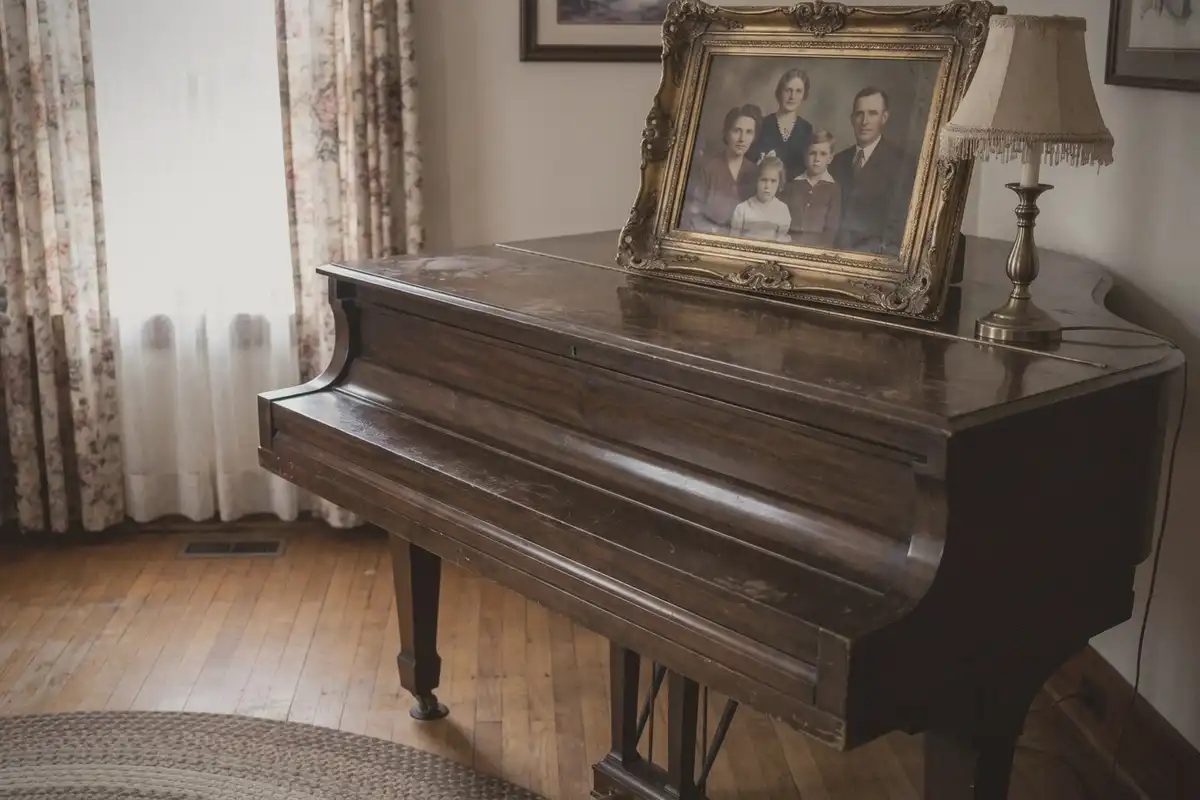
I spent Wednesday in my little kitchen making two sweet potato pies and three dozen yeast rolls, the way my mother made them. While the dough was rising, I walked over to the house to borrow Nicole’s big mixing bowl.
Emma was at the piano, playing “In the Garden,” slow and careful, the way her grandfather taught her. She didn’t know I was standing in the hall.
I stayed right there until she finished. Then I slipped back out the way I came, without the bowl.
Grant’s mother drove up from two hours away and got there at 4:00. She hugged Grant, hugged the children, and told me I looked tired.
Grant’s mother believes the man should handle the money and everybody else should say thank you. She told me so herself, the first Christmas I met her.
Thanksgiving dinner was at 1:00. Nicole had set the table with her good plates.
Grant sat at the head. Nicole sat on his right, and I sat next to Nicole.
Across from us, with their backs to the sideboard, sat Grant’s mother and Emma, with Emma right across from me. Mason had the foot of the table.
Behind Emma’s head hung that big old mirror. It hung in my dining room for most of my married life, and when I sold the house, I gave it to Nicole. From my chair, I could see the whole table in it.
My own face. My daughter beside me. And behind the two of us, through the wide doorway to the front room, my husband’s piano.
Grant gave the blessing. He thanked the Lord for providing. Then he carved the turkey, and everybody swore my rolls were the best yet.
Somewhere between the green beans and the second helping of dressing, I glanced up at the mirror. In the corner of it, I could see Grant with his phone down low beside his plate.
He looked at a message and smiled. It was a small, private smile, the kind a boy gets on the back seat of a bus when he’s gotten away with something.
I didn’t know yet who that message was from.
A little after 2:00, Grant pushed back his chair and tapped his fork against his tea glass.
He stood up. “Big news, everybody.”
He looked around the table like a game show host. “I sold the piano.”
Nobody said a word. Emma’s fork stopped halfway to her mouth.
Grant kept right on going. “A dealer named Pratt. Pratt’s Piano Exchange, over in the next county. He came by and looked at it this week. Mr. Pratt is picking it up Saturday morning at 10:00. $4,500.”
He grinned at Mason. “And the new television goes right where it sat. Seventy-five inches. Doors open at 6:00 tomorrow.”
Emma lowered her fork. “Dad. That’s Grandpa’s piano.”
Grant barely glanced at her. “Grandpa’s gone, sweetheart. You can practice on a keyboard. They make good ones now.”
I set my fork on the edge of my plate. I kept my voice at the level I used for a bus full of children coming home from a field trip.
Not loud. Just clear.
I said, “Grant, that piano isn’t yours to sell.”
He turned and looked right at me, and he didn’t blink.
He said, “We’ve been carrying you for two years, Loretta. The piano is the least you owe us.”
His mother laughed out loud. She put her hand on her chest and laughed like he’d told the best joke of the year.
And Mason laughed too. He’s 17. He laughed the way boys laugh on a bus when they don’t know what else to do with their faces.
Nicole didn’t laugh. She looked down at her plate.
I didn’t look at Grant. I looked up into the mirror, at my daughter’s face, the way Thelma taught me all those years ago. You learn who people are by watching the mirror when they think you’re not looking.
Nicole wasn’t surprised. Not one bit. She was tired, and she was embarrassed, and she wished it were over.
But she had known. She had known before she ever set out those good plates.
That was the part that hurt. Grant’s words I could stand. It was my daughter’s face in that old mirror.
Emma shoved back her chair so hard it scraped the floor, and she ran upstairs crying. Nobody went after her.
Two years, Grant had said. It would be two years on Tuesday. He had rounded up.
Grant always rounds up when the number helps him. He had watched me say yes to nearly everything for two years, and he thought he knew what I’d say this time.
I folded my napkin in half and laid it beside my plate. “Thank you for dinner, Nicole. The turkey was lovely.”
Then I got up, walked out through the kitchen, crossed the yard, and climbed my fourteen steps. I didn’t hurry. A driver who hurries in front of children teaches them to panic.
Up in my apartment, I sat down in Vernon’s old recliner, the biggest thing from our old living room that made it up those steps, and I let myself cry. Just me and his picture on the side table. Then I washed my face.
I had a choice to make. I could march back down there and turn that table upside down in front of Grant’s mother. Or I could do what I did for thirty-one years whenever a bus got loud.
Pull over. Set the brake. Handle one thing at a time.
I thought about that word of his. Carrying. I carried children for thirty-one years, sixty at a time some years, up and down those hill roads in the dark and the ice.
I know what carrying is. And I knew this, too. Carrying someone and riding on them are not the same thing.
At 7:30, I went back down. Grant’s mother was in the den with the football game turned up loud.
Grant was drying dishes. Nicole was wrapping up the turkey.
I stood in the kitchen doorway and gave him his chance. “Grant, call Mr. Pratt in the morning. Tell him the piano isn’t yours to sell. Give him back whatever he paid you. And then tell Nicole whose card has been buying the groceries in this house.”
Grant didn’t even turn around. He just said, “I’m not calling anybody, Loretta. It’s done. Mason and I leave at 5:30. Doors open at 6:00.”
Nicole didn’t look up from the turkey. “Mom, please. Not tonight. His mother is right in the next room.”
So I went back up my steps.
I sat at my little table and thought about that television. And I knew exactly which card Grant meant to hand the cashier.
My name. My account. My bill.
I didn’t need a lawyer to tell me I could take a man off my own credit card.
At 11:40 that night, I turned my card over and called the number printed on the back. That line answers all night. A woman with a soft voice asked me some questions to make sure I was really me.
I told her I wanted to remove an authorized user, and I gave her Grant’s name.
She said, “All right, Mrs. Dempsey. He’s been removed. His card should stop working right away. Once in a while, it takes a day to catch up.”
I thanked her, and I went to bed, and I slept.
At 6:50 the next morning, somebody pounded on my door so hard the coffee cups rattled on their hooks.
I opened it in my robe. Grant stood on the landing with his face the color of a brick. Mason was halfway up the steps behind him, holding the rail, looking like he’d rather be anywhere else on this earth.
Grant didn’t bother with hello. “What did you do to my card?”
“Good morning, Grant.”
He was nearly shouting, and he said, “I stood at that register with a seventy-five-inch television on a cart and a line out the door behind me, and it said declined. Twice. I called the number on the back, and a recording told me the card was closed. What did you do?”
“It was never your card, Grant. It’s mine. My name, my account. I took you off it last night.”
He shook his head hard. “That’s the family card. The kids’ things are on that card.”
“The kids’ things were on it because I paid for them. I’ll keep paying for my grandchildren. I just won’t be doing it through you.”
He pointed his finger at me, and it shook. “You’re confused, Loretta. You’ve been confused ever since Vernon died. Everybody’s noticed.”
I didn’t raise my voice. “It isn’t 7:00 yet. You can still call Mr. Pratt this morning. Give him back his money and tell him there’s been a mistake. That offer is good until his truck pulls in on Saturday.”
Grant laughed at me, one short bark, and went back down the steps. Mason looked up at me for a long moment. Then he followed his father.
At 8:30, as I came down my steps to go to the bank, Grant’s mother was loading her suitcase into her car. She stopped with her keys in her hand. “After all they’ve done for you, Loretta. I hope you’re proud of yourself.”
“You drive safe. The roads get busy the day after a holiday.”
My bank opens at 9:00 on the Friday after Thanksgiving, same as any Friday, and I was standing at the door when they unlocked it.
The branch manager is a young man named Wesley. He rode my bus from kindergarten through the fifth grade.
He used to fall asleep with his cheek pressed against the window, and I’d have to call his name twice at his stop. Now he wears a tie and has an office with a glass wall.
He stood up when I walked in. “Mrs. Dempsey. What can I do for you?”
I told him all of it.
Wesley typed for a while. Then he turned his screen so I could see it. “Mrs. Dempsey, do you know whose email address this is?”
It was Grant’s. For two years, every statement on my checking account and my credit card had gone straight to my son-in-law. I hadn’t seen a single one.
Wesley was careful with me. He said, “I can stop what Grant set up to come out of your account, from today on. What happens with his truck after that is between him and his lender. I can’t tell you how that will go.”
We went through it one thing at a time, the way I used to do my safety check. He changed my password and put my own email on the account.
He set my statements to come on paper, too. He found the truck payment sitting in my bill pay, scheduled for December 3, and he deleted it while I watched.
Then he checked my certificates of deposit, the money from my house. Nobody had touched them. Wesley said they can’t be cashed unless I’m standing at that counter signing for them myself, and my shoulders came down about two inches.
Then he printed every statement on both accounts going back to December of 2023. The stack was as thick as a church hymnal.
Last, he walked me back to the vault, and I opened my safe deposit box. Inside was the bill of sale for the piano, in that old teacher’s neat handwriting.
Beside it was my copy of Vernon’s will. The original was filed at the courthouse after he passed.
It left everything he owned to me. Wesley made me copies of both, and I put the original bill of sale back in the box and locked it.
I sat in my car in the bank parking lot with a pencil and that stack of paper for most of an hour.
Bus drivers keep logs. Mileage, fuel, every stop. I know how to add a column.
Groceries on my card, from January of 2024 through November of 2025, came to $19,200. Emma’s lessons, Mason’s ball fees, and school things for both children came to $6,150.
Then there was a third pile. Gas for Grant’s truck. His lunches.
A hardware store. A sporting goods store. That pile came to $6,130, and not a dime of it was for anybody but Grant.
Then the truck. $612 on the 3rd of every month.
I had agreed to a few months. I counted twenty.